Does It Rain in the Pantheon in Rome? Yes, and the Basilica Says So Itself
Rain does fall through the oculus of the Pantheon in Rome, and the Basilica itself calls the no-rain legend false. What the floor does with the water, why nobody can count the drains, and how wet November really is.
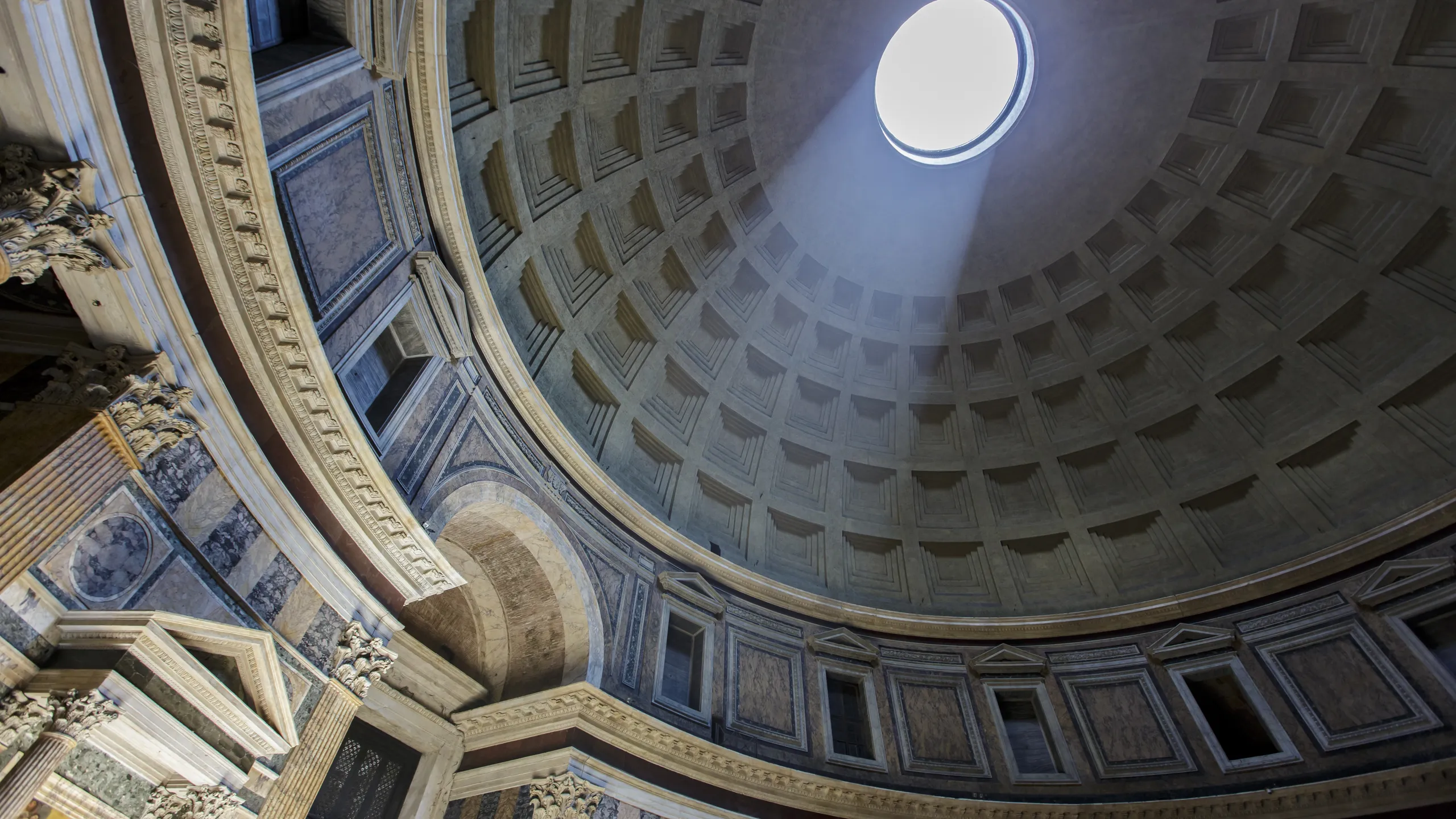
Does it rain in the Pantheon? Yes. The dome has a hole about nine metres across, nothing covers it, and when it rains the water lands on the marble floor and runs away through drains built to take it.
The surprise is who says so. It is not a sceptical blog. It is the Basilica itself, the body that holds services in the building, on its own page about the oculus: "The most famous—and false—legend claims that the rain never enters the building." We opened that page on 4 November 2026 and the sentence is there.
We are publishing this in the month when it matters. November is the wettest month in the official climate file for Rome's nearest weather station, and the question stops being a curiosity when you are choosing between a wet morning in the square and a dry afternoon somewhere else.
Does it rain in the Pantheon? The Basilica says yes, in so many words
The page is the Basilica's article on the oculus, which its web address dates to January 2026. Its author does not hedge about the roof. When it rains, the page says, the water "falls directly onto the marble floor and drains away through hidden holes".
The same page explains where the legend comes from, and this is the part worth reading slowly. The myth, it says, "stems from the powerful thermal draft created by the difference in temperature between the inside and outside". That draft is real. By the Basilica's account it can sometimes atomise raindrops into a fine mist. Sometimes, and into mist: nothing in the sentence says it stops a shower.
The most famous—and false—legend claims that the rain never enters the building.
We should be straight about how we use that source. On this site the Basilica's pages count for opening times, services and the state of the building, and not for numbers or history, because the same page gives the oculus as 8.2 metres across. Surveys by Platner and Ashby, by Marder and Wilson Jones and by Aung and Bork converge on about nine, which is thirty Roman feet. The 8.2 looks like "27 feet" read where "30" was meant.
A rain sentence is not a measurement, and no source we know of disputes it. It is also an institution puncturing a legend that flatters its own building, which is not what a source with something to sell usually does.
Some arithmetic
Pantheon oculus rain: how much actually falls in
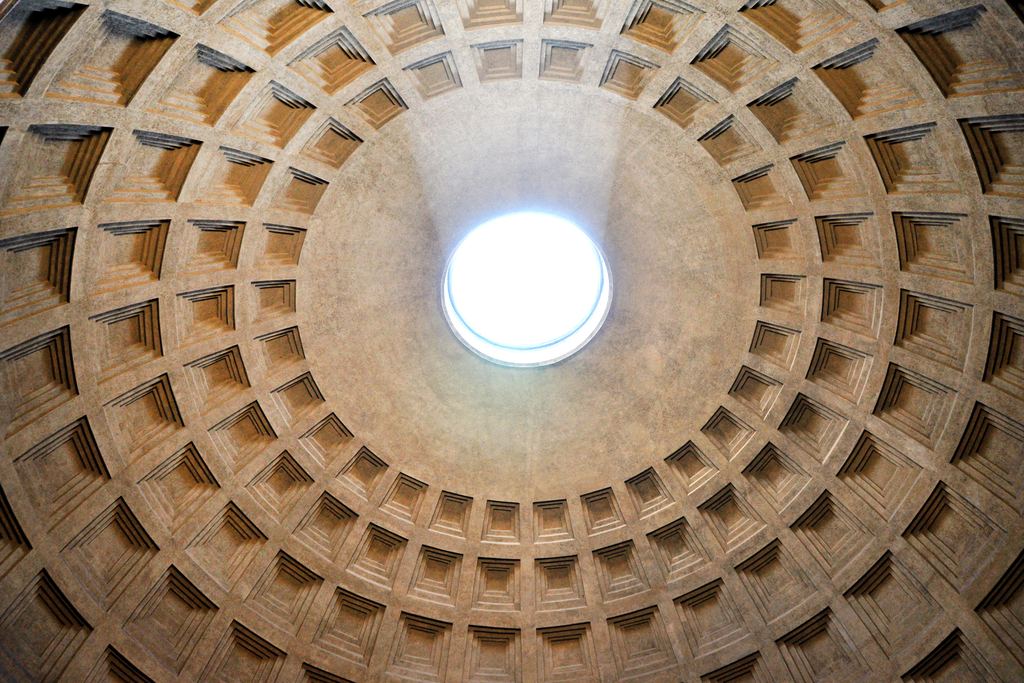
The opening is about nine metres across, which makes roughly 64 square metres of open sky. One millimetre of rain is one litre on every square metre, so each millimetre drops about 64 litres through the oculus.
Multiply by the climate file. November's normal at Rome Ciampino is 112.8 mm, so a whole November puts something like 7,000 litres through the hole. Use the Basilica's 8.2 metres instead and it is about 6,000.
This is arithmetic, not a measurement. It assumes rain falls straight down, ignores wind, and uses an airport station rather than the roof of the Pantheon. Spread over a month it is a modest amount of water. A heavy day of 20 mm is about 1,300 litres, arriving in the middle of the floor.
Pantheon Rome drainage: the holes nobody has counted
The water has to go somewhere, and the building was made so that it does. What is documented is modest and clear: a large drain cover in the centre of the rotunda and ancient drains under the pavement, both named in Marder and Wilson Jones's 2015 Cambridge volume, which we checked in August 2026. They work. The Basilica says the water "drains away", and that is what the floor has done for nearly nineteen centuries.
What is not documented is a count. A precise number of holes circulates in Italian popular sources and has been copied into English guides. The Cambridge volume never counts the holes. Platner and Ashby give no figure, Wikipedia in English gives none, and Italian Wikipedia marks the figure as lacking a source. We tried three independent routes in August 2026 and found no survey behind it.
So we do not print a number, and if you read one elsewhere, ask where it comes from. "We don't know" is a better answer than a figure that has been repeated until it feels like a fact.
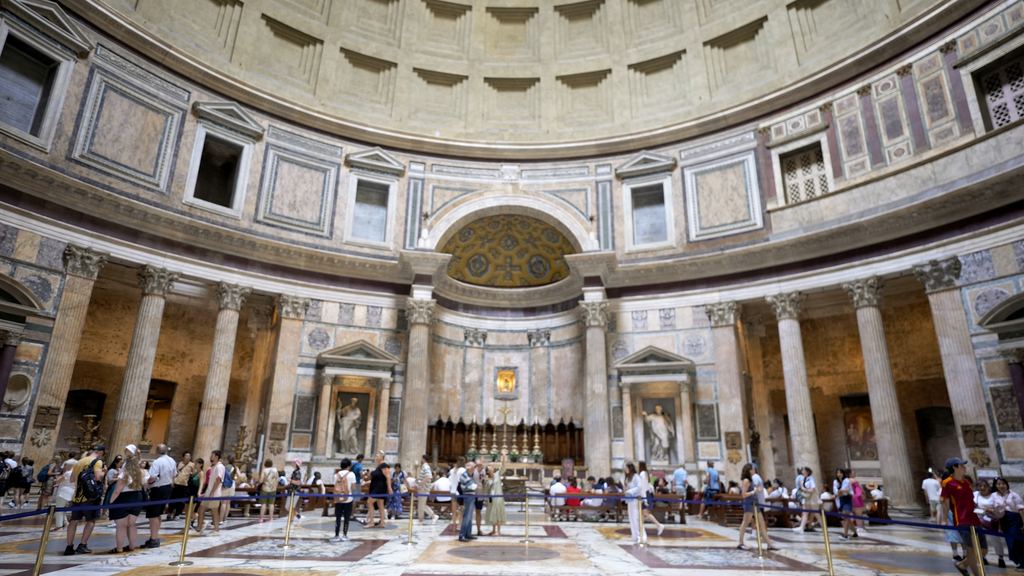
One more thing about the floor that gets wet. Its design, its marbles and its colours are ancient, but by Mario Lolli Ghetti's estimate about two thirds of the surface is modern or ancient material laid again, mostly in the campaign of 1873. The accurate phrase is that it reproduces the ancient pavement faithfully, not that it is the original.
Why the legend survives, and a history we could not confirm
A building with a hole in its roof ought to get wet. A building that keeps its visitors dry is a better story, and the story has a seed of truth in the draft, which is why it has lasted.
You will also find a neat argument online that popes and architects spent four centuries drawing covers for the oculus, which would make no sense if rain stayed out. The names attached to it are Giacomo della Porta in 1591, Alexander VII in 1660 and James Gibbs in the eighteenth century, plus a tomb proposed for the centre of the floor and refused in 1880 because the ancient drains would not have coped. It is a good story and it points the right way. We went looking for a primary source and found it only on tourism pages that cite nothing, so it is not part of our case. The proof here is one sentence from the Basilica and a set of drains that exist.
Our page of Pantheon myths lists the other things that get repeated, and our page on the dome and the oculus has the measurements, with the disagreements between surveys left in. For what the opening does with sunlight rather than water, see the earlier piece on the oculus light in autumn.
Pantheon Rome when it rains: what the published rules leave open
Here the honest answer is mostly a list of what we could not find. No source we have on file says how staff manage the wet patch under the opening, whether part of the floor is roped off in a downpour, or whether the monument changes anything on a wet day. The Ministry's visitor rules we hold cover food and drink, smoking, phone calls, animals and dress. Umbrellas are not mentioned, and absence is not permission, so ask at the door.
What we can say is about the square and the queue.
- The square has no cover. The line forms in Piazza della Rotonda, in the open.
- The door has three queues. Cash is on the left of the entrance, and in the accounts we collected it clears in 5 to 15 minutes even in high season. The card machines are on the other side, and that is the long line. Our page on the three queues explains them.
- Tickets are for a timed slot, with up to 1,200 people allowed per slot and nine slots between 9:00 and 18:00.
The dress rule does not bend for the weather in anything we have read: shoulders and knees covered, and staff are authorised to refuse entry. Our what-to-bring page has the details.
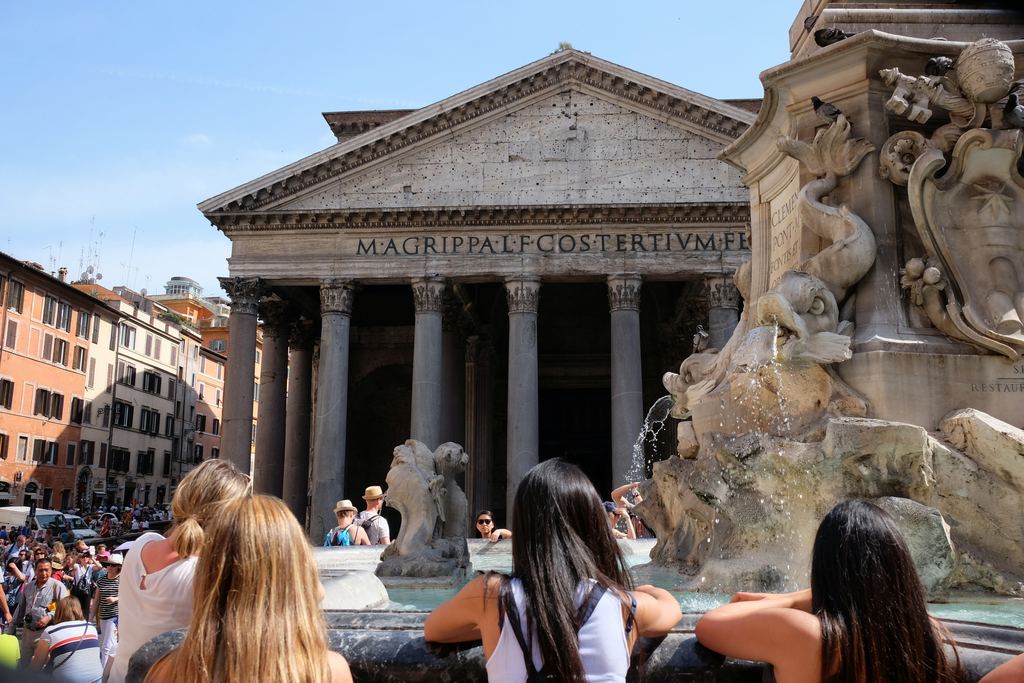
How much it rains: the month-by-month normals
The figures below are the official WMO 1991-2020 normals for Rome Ciampino (station 16239), archived by NOAA. Three caveats. The summer rainfall cells are empty because the file records them as missing in Italy's submission, and we have not filled them from another station. Ciampino is an airport on the edge of the city, and ISPRA's readings put the centre warmer and wetter. And these are averages: a given November can be far wetter or far drier.
| Month | Rain (mm) | Days with 1 mm or more | Average high (°C) | Average low (°C) |
|---|---|---|---|---|
| January | 68.4 | 7.8 | 12.0 | 3.4 |
| February | 65.4 | 7.7 | 13.0 | 3.4 |
| March | 62.0 | 7.2 | 15.8 | 5.9 |
| April | 74.4 | 8.1 | 18.8 | 8.6 |
| May | 61.6 | 6.0 | 23.4 | 12.6 |
| June | - | - | 28.1 | 16.7 |
| July | - | - | 31.0 | 19.3 |
| August | - | - | 31.6 | 19.8 |
| September | 67.6 | 6.3 | 26.7 | 16.0 |
| October | 91.8 | 7.7 | 22.2 | 12.4 |
| November | 112.8 | 9.3 | 16.9 | 8.5 |
| December | 102.5 | 10.0 | 12.7 | 4.7 |
| 1 | 2 | 3 | 4 | 5 | 6 | 7 | 8 | 9 | 10 | 11 | 12 |
November is the wettest month by volume, at 112.8 mm, with December close behind at 102.5. December has the most rainy days, 10.0 against 9.3, so November rains harder and December rains more often. October, at 91.8 mm, is already well above the 62 to 74 mm of the months from January to May and September. For the three summer months the official file does not say, so we will not either.
November is also the quietest month of the autumn. Our reconstruction of Rome's arrivals puts November at an index of 91 against 117 for October, where 100 is the average month. That curve is a reconstruction, not a count at the door: the Pantheon publishes no monthly figures.
A wet morning in Rome: where to be instead of the square
If the forecast is bad and your slot is not until the afternoon, the quarter has dry options, and several cost nothing. The prices below are from our notes of August 2026 and are worth checking again before you rely on them.
Dry places near the Pantheon
Status and prices as in our August 2026 notes.
Churches that cost nothing
Santa Maria sopra Minerva, with Bernini's elephant outside, San Luigi dei Francesi with its three Caravaggios, and the Gesù are free to enter. Sant'Ignazio is free too, but forum complaints describe a long queue for a coin-operated light.
A palace gallery
Palazzo Doria Pamphilj costs €16 to €17 on the official channel. Resellers list it near €32, which is the gap worth knowing about before you book.
The Pantheon with someone explaining it
A guided visit puts the explanation under the hole itself, which is the point on a wet day. Our expert-led category lists the ones that go inside.
The free churches also hold the Caravaggios, and our piece on the Caravaggio churches near the Pantheon covers the three doors and the narrow viewing window. The palaces and private galleries category has the indoor rest of the quarter.
Questions about rain at the Pantheon
Does it rain inside the Pantheon?
Yes. The oculus at the top of the dome is open to the sky, and rain that falls through it lands on the marble floor and drains away. The Basilica says so on its own page about the oculus, which we read on 4 November 2026, and calls the idea that rain never enters the building a false legend.
Doesn't the hot air stop the rain from coming in?
No. A thermal draft exists, and the Basilica says it can sometimes turn raindrops into a fine mist. That is a long way from keeping a shower out, and its own page says the water falls onto the floor and drains away.
How many drain holes are there in the Pantheon floor?
Nobody has published a count we could verify. The ancient drainage under the pavement is documented, and a large drain cover in the centre of the rotunda is mentioned in the 2015 Cambridge volume, but the holes are not counted there. A precise number circulates online, and we found no survey behind it.
Is the Pantheon open when it rains?
We found nothing that says it closes for rain. The closures we have on file are 25 December and 1 January on the Ministry's page, with the Basilica's own page adding 15 August. Neither mentions the weather. Check the Ministry's page for the day if the forecast is severe.
Can I take an umbrella into the Pantheon?
We found no published rule either way. The rules we hold cover food and drink, smoking, phone calls, animals and dress, and umbrellas are not among them. Absence of a rule is not permission, so ask the staff at the door.
How much rain actually comes through the oculus?
As arithmetic, not a measurement: the opening is about 64 square metres, so each millimetre of rain puts in about 64 litres. A whole November at Rome Ciampino's normal of 112.8 mm would be something like 7,000 litres, assuming the rain falls straight down.
Which is the wettest month for a visit to Rome?
November, at 112.8 mm in the official 1991-2020 normals for Rome Ciampino, followed by December at 102.5 mm and October at 91.8 mm. The normals for June to August are missing in the official file, so we cannot rank the summer.
Check the dress rule before you queue in the rain
Shoulders and knees covered, and staff may refuse entry. Our what-to-bring page has what the Ministry publishes, and what it does not.
Expert-led visits that go inside
Three visits from our Expert-Led category that go inside the building, ordered by number of reviews, most first. None of them promises priority entry, because the Pantheon has none.
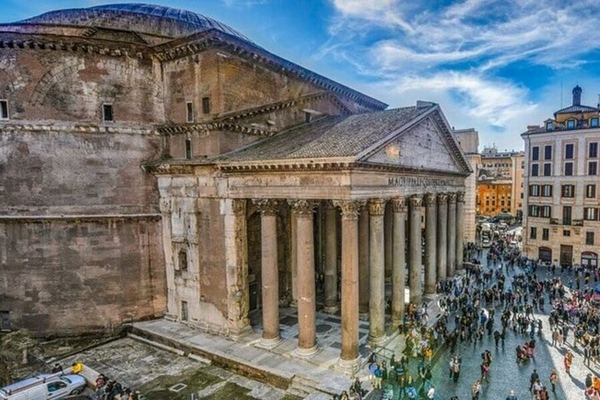
Pantheon Ticket with Audio and an Optional Basilica of Neptune Tour
The upgrade adds an official guide through parts of the complex the standard ticket does not cover. Tickets arrive by WhatsApp, not on the voucher.
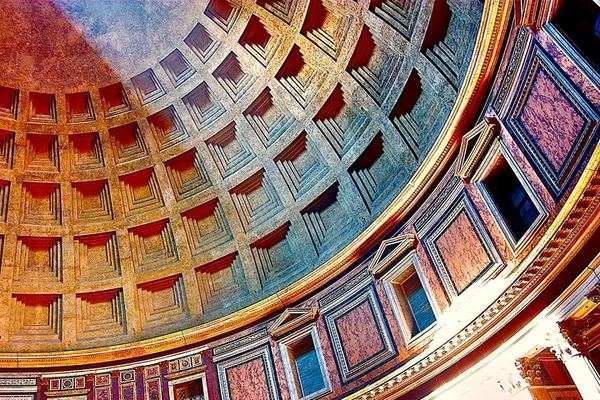
The Pantheon Explained: Dome, Oculus, Niches and Tombs
A guided visit that takes the building apart in four pieces, including what the nine-metre opening is for besides letting the light in.

From the Capuchin Crypt to the Pantheon, Ending Inside the Rotunda
From a room of arranged bones to the calmest interior in Rome, in that order on purpose, finishing inside the rotunda rather than in the square.
Ratings collected by Viator and Tripadvisor
Data verified on . Rain quotes: Pantheon Basilica oculus page, read 4 Nov 2026. Climate: WMO 1991-2020 normals, Rome Ciampino. Other site data from our notes of Aug 2026.