
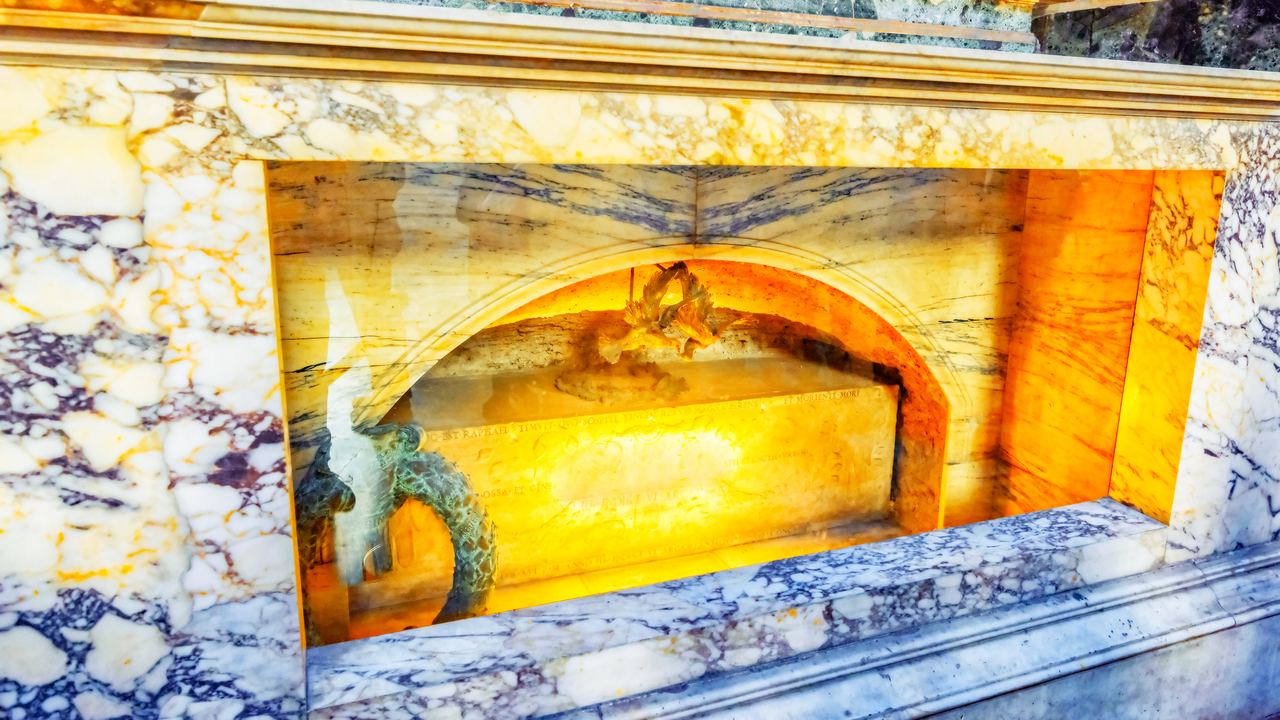
The Pantheon holds tombs, and it holds monuments to people who are buried somewhere else, and for two centuries it held busts of people with no connection to it at all. Most accounts run the three together, which is how Michelangelo ends up on lists of who is buried here.
This page separates them. Where a claim is contested we have said so.
The fourteen
| Who | What they did | Died | Note |
|---|---|---|---|
| Raphael | Painter and architect | 1520 | In an ancient sarcophagus since 1833, given by Gregory XVI |
| Maria Bibbiena | Betrothed to Raphael | 1520 | A separate burial with her own inscription, not sharing his tomb |
| Desiderio d'Adiutorio | Canon, founded the Virtuosi | 1546 | Under the altar of the chapel of St Joseph |
| Perin del Vaga | Painter | 1547 | Chapel of St Joseph |
| Baldassarre Peruzzi | Architect and painter | 1536 | Buried next to Raphael. The present plaque was placed by the Sienese in 1921 |
| Giovanni da Udine | Painter and stuccoist | 1561 | |
| Taddeo Zuccari | Painter | 1566 | Bust and inscription set up by his brother Federico |
| Jacopo Barozzi da Vignola | Architect | 1573 | |
| Flaminio Vacca | Sculptor | 1605 | |
| Annibale Carracci | Painter | 1609 | Buried at his own request. Carlo Maratti added a bust in 1674, to pair with Raphael's |
| Arcangelo Corelli | Composer | 1713 | Buried in three coffins, lead inside cypress inside chestnut |
| Vittorio Emanuele II | First king of Italy | 1878 | Interred 17 January 1878, monument by Manfredo Manfredi |
| Umberto I | Second king of Italy | 1900 | Assassinated at Monza |
| Margherita of Savoy | Queen consort | 1926 |
The artists are there because of an institution rather than a whim. In 1545 the confraternity of St Joseph of the Holy Land, known as the Virtuosi, obtained the right to grant burial in the Pantheon to its own members. Raphael's interment in 1520 predates that, which makes him the precedent rather than a beneficiary.
Raphael did not receive his tomb. He bought it
The standard telling has a grateful pope granting the tomb as an honour. What the sources record is a transaction: Raphael purchased the burial place and paid to restore an ancient aedicule at his own expense, and left instructions in his will for a marble statue of the Virgin to stand above it.
That statue exists. It is the Madonna del Sasso by Lorenzo Lotti, called Lorenzetto, contracted on 10 February 1521 and made between about 1520 and 1524, finished by assistants including Raffaello da Montelupo. Vasari records the testamentary instruction.
The famous epitaph, which turns on the conceit that Nature feared to be outdone while he lived and to die with him, is attributed to Pietro Bembo by the ministry. The Italian biographical dictionary leaves the question open between Bembo and Tebaldeo, and we would rather say that than pick one.
And he was not the first person buried in the building. It had been a Christian basilica with relics for nine hundred years. He was the first modern artist, which is a much more interesting claim and the one worth making.

1833
The year they opened the tomb
By the 1830s there was a genuine scholarly dispute about whether Raphael was in the Pantheon at all. The antiquarian Carlo Fea argued he was at Santa Maria sopra Minerva instead.
The sculptor Giuseppe De Fabris pushed for an excavation, with Gregory XVI's backing and against the Accademia di San Luca's objections. Digging began on 9 September 1833, the remains were found on the 14th, and on 18 October they were reinterred in a pine coffin inside a lead one, inside the ancient marble sarcophagus the pope provided. A notary recorded it, a surgeon examined the bones and Vincenzo Camuccini drew them.
There is a coda. The Accademia di San Luca had been displaying a skull as Raphael's. It was not: it belonged to Desiderio d'Adiutorio, the canon who founded the Virtuosi, and it was returned with his urn in March 1893. A plaster cast of the real skull, taken in 1833, is at Urbino.
The kings, and the men who still stand guard
Two kings and a queen of Italy are buried in the right-hand and left-hand exedrae, and this is the reason the bell towers came down in 1883: a newly secular state wanted a Roman monument for its royal tombs, not a baroque basilica.
They are still guarded. The Istituto Nazionale per la Guardia d'Onore alle Reali Tombe del Pantheon was founded on 18 January 1878, nine days after Vittorio Emanuele II died, and it still exists: a recognised body under the supervision of the Ministry of Defence, self-funded, with around 2,500 members.
The service is voluntary and unpaid. Members stand two-hour watches in dark civilian dress, with a cape and cap that are optional, and keep a register that visitors may sign. There is no published rota, so we cannot tell you when you will find them there, and anyone who gives you exact hours is guessing.
A frequent confusion worth clearing up: Vittorio Emanuele III and Queen Elena are not here. Their remains returned to Italy in December 2017 and lie at the sanctuary of Vicoforte, near Cuneo. Umberto II and Maria José are at Hautecombe Abbey in France.
The busts that left, and the cardinal who only partly stayed
Between about 1780 and 1809 the Pantheon filled up with commemorative busts of great Italians who were buried elsewhere: Michelangelo, Dante, Tasso, Palladio, Titian, Correggio, Veronese, and non-Italians including Poussin, Mengs and Winckelmann.
In 1820 Pius VII had them moved out to the Protomoteca on the Capitoline, which opened that year to receive them. This is the origin of the persistent belief that Michelangelo is buried in the Pantheon. He is in Santa Croce in Florence, and always was.
Note what was moved: the busts, not the graves. Corelli's bust went to the Capitoline; Corelli did not. He is still here, which is worth knowing because several accounts have him relocated.
One genuine oddity. Cardinal Ercole Consalvi, Pius VII's secretary of state, has a monument here with a bust by Thorvaldsen, and the Pantheon holds his heart. The rest of him is at San Marcello al Corso. He belongs on neither list cleanly, which is why he is usually left off both.
Questions about the tombs
Who is buried in the Pantheon?
Fourteen people can be documented by name: Raphael, Maria Bibbiena, Baldassarre Peruzzi, Perin del Vaga, Giovanni da Udine, Taddeo Zuccari, Vignola, Flaminio Vacca, Annibale Carracci, the canon Desiderio d'Adiutorio, the composer Arcangelo Corelli, and King Vittorio Emanuele II, King Umberto I and Queen Margherita.
Is Michelangelo buried in the Pantheon?
No. He is in Santa Croce in Florence. He had a commemorative bust in the Pantheon between the 1780s and 1820, when Pius VII moved all such busts to the Capitoline, and the question has outlived them.
Did Raphael get his tomb as a gift?
No, he bought it and paid to restore the ancient aedicule around it, leaving instructions in his will for the Madonna above it. That statue is Lorenzetto's, contracted in February 1521.
Was Raphael the first person buried here?
No. The building had been a Christian basilica since the seventh century and contains medieval grave slabs. He was the first modern artist to be buried here, which set the precedent for everyone who followed.
Are the Italian kings still guarded?
Yes. A volunteer body founded in January 1878 keeps an honour guard at the royal tombs, unpaid, in two-hour watches. There is no published timetable, so whether you find them there is a matter of luck.
Is Victor Emmanuel III buried in the Pantheon?
No. He and Queen Elena were returned to Italy in December 2017 and are at the sanctuary of Vicoforte in Piedmont. Only Vittorio Emanuele II, Umberto I and Margherita are in the Pantheon.
Someone to point out which is which
The tombs are the part of the building where a guide earns the fee, because almost nothing here is labelled in a way that separates a grave from a monument.
Best of Rome Private Walk with Pantheon and Trevi Tickets
Two booked entries rather than one: inside the Pantheon, and down at the Trevi basin, where access is now controlled and a slot decides where you stand.
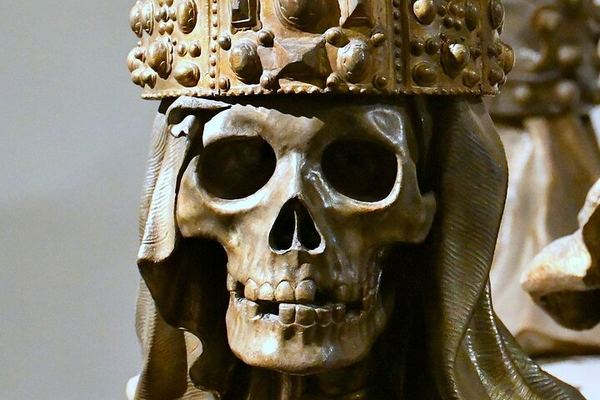
From the Capuchin Crypt to the Pantheon, Ending Inside the Rotunda
From a room of arranged bones to the calmest interior in Rome, in that order on purpose, finishing inside the rotunda rather than in the square.
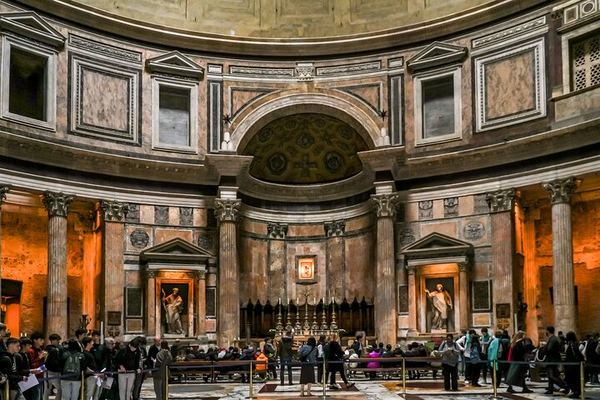
Pantheon Guided Tour in 45 Minutes, with the Chapels and the Tombs
A tour specific about what it shows: two named chapels, the statues of Jupiter, Venus and Mars, and the tombs including Queen Margherita's.
Ratings collected by Viator and Tripadvisor
Why artists wanted to be buried in a Roman temple
The obvious question about this list is why a painter would want to lie in a converted pagan temple rather than in a church of his own city, and the answer is institutional rather than romantic.
In 1545 the confraternity of St Joseph of the Holy Land, known as the Virtuosi al Pantheon, obtained the right to grant burial here to its own members. That turned a privilege into a membership benefit: joining the confraternity was how a working artist in Rome acquired a claim on the most conspicuous building in the city. Nearly everyone on the list above, from Perin del Vaga to Annibale Carracci, is there through that route.
Raphael predates the arrangement by twenty-five years and is the reason it exists. His burial in 1520, in a tomb he had bought and an ancient shrine he had paid to restore, established that a modern artist could be commemorated among the antiquities rather than merely beside them. Everything afterwards is the institutionalisation of that precedent.
It also explains the pattern of the busts. Between the 1780s and 1809 the building filled with marble heads of great Italians buried elsewhere, because by then the Pantheon had become the place where reputations were displayed rather than where bodies happened to be. When Pius VII cleared them out in 1820 he was undoing an argument about national memory, and sixty years later the Italian state made the same argument again by putting two kings here.
Three separate institutions decided in turn that this room was where Italy kept the people it wanted remembered: a confraternity of painters, a pope, and a monarchy. Only the first of them asked the dead.
Data verified on. Burials, the 1833 exhumation and the Lorenzetto commission from the Dizionario Biografico degli Italiani and Marder and Wilson Jones, The Pantheon (Cambridge, 2015).