
The Pantheon Oculus Light in Autumn: Where Rome's Sunbeam Goes When It Leaves the Floor
The disc of sunlight from the oculus left the Pantheon's floor on 10 August and spent September climbing the entrance wall. We calculated where it lands every week until the solstice, at what time by the clock, and what the hour change on 25 October does to it.
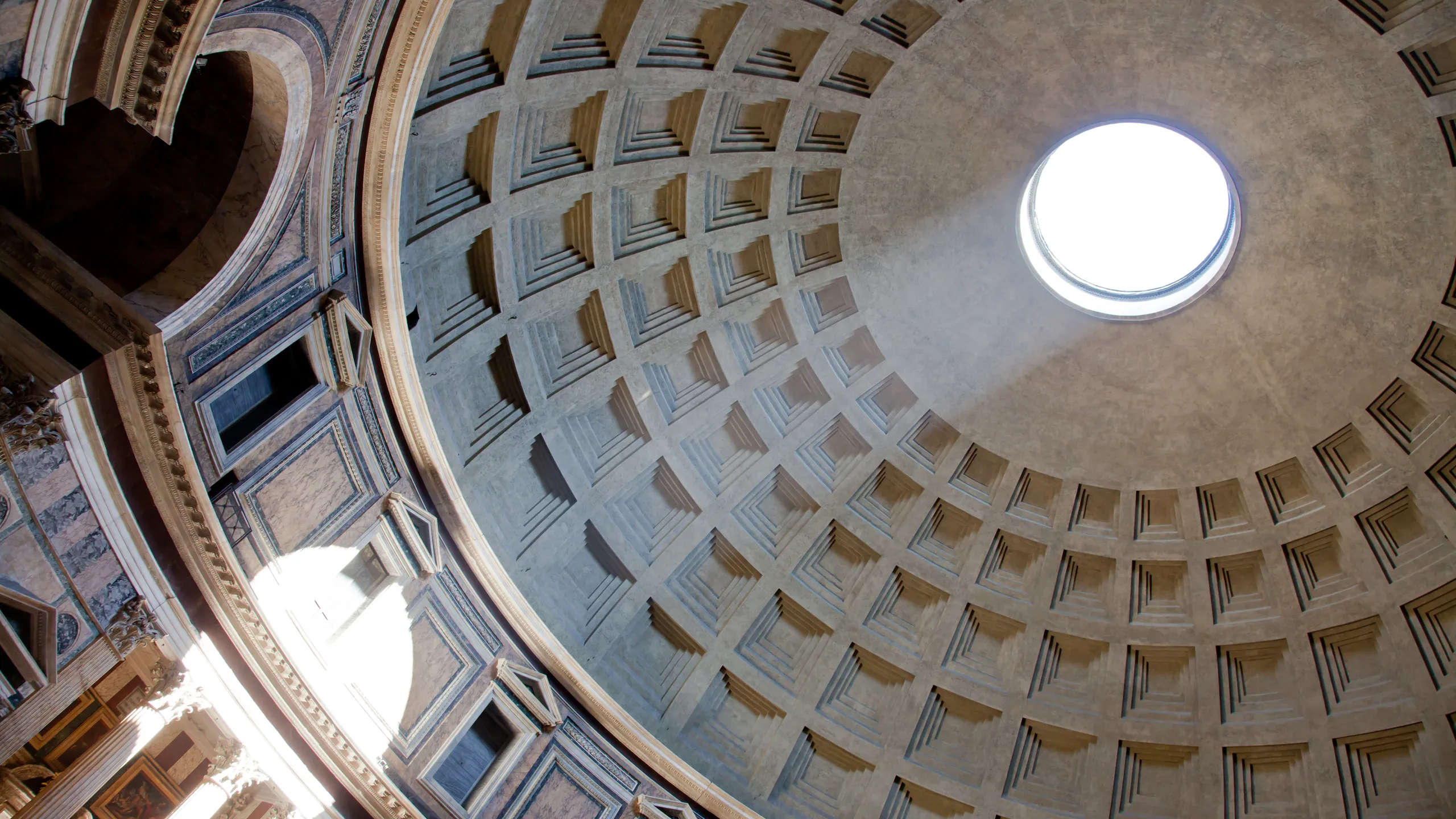
The Pantheon oculus light is up on the wall today, roughly 19 metres above the floor, and by Christmas it will be near the top of the dome. It stopped touching the pavement on 10 August and it will not be back until May. Almost every photograph of this building shows the one thing that is not happening inside it right now.
That is not a complaint about autumn. The light moves further between the equinox and the solstice than it does across the whole of summer, and it moves on a timetable that can be printed in advance, because the thing is arithmetic rather than weather: where the sun is, and what shape the room is. We ran both for every week between today and 21 December.
What the Pantheon oculus light does when the sun drops
The rotunda is as wide as it is tall, about 43.3 metres either way. The drum, which is the cylindrical wall you stand inside, stops at 21.65 m, exactly half the height, and the dome curves up from there. That single proportion decides everything about the light. The measurements themselves, and the places where surveys disagree about them, are set out on our page about the dome and the oculus.
A beam coming through the opening falls at whatever angle the sun happens to be at. To clear the drum and reach the pavement, the sun has to stand higher than 63.4 degrees. Rome is at 41.9 degrees north, so that happens for about a hundred days a year. Our figures for this year give 2 May to 10 August, which is 101 of them, give or take a day at either end depending on the year.
Below 63.4 degrees the disc lands on the drum wall instead. Below 45 degrees it does not reach the wall at all and stops on the dome, among the coffers. Those two thresholds are the whole of autumn. In the middle of today the sun over Rome gets to 47.8 degrees, so the light is on the wall, well above the door. Next Wednesday it manages 45.1, about as close to the join between wall and dome as it ever comes. After that it is on the curve until March.
Autumn week by week, and the hour that vanishes
The times below are the moment the beam crosses the axis of the building, which is neither noon nor solar noon. Two separate things push it about. Italian clocks are set to a meridian well east of Rome, which already puts solar noon about ten minutes late, and summer time adds an hour on top until 25 October. Then there is the building, turned roughly four and a half degrees west of north, so the beam sweeps over its axis about ten minutes before the sun reaches due south.
| Date | On the axis | Sun's height | Where the disc lands |
|---|---|---|---|
| 23 September | 12:50 CEST | 47.8 degrees | Entrance wall, 19.4 m up |
| 30 September | 12:47 CEST | 45.1 degrees | Entrance wall, 21.6 m, just under the springing |
| 7 October | 12:44 CEST | 42.4 degrees | Dome, 23.6 m up |
| 14 October | 12:42 CEST | 39.8 degrees | Dome, 25.6 m |
| 21 October | 12:40 CEST | 37.2 degrees | Dome, 27.5 m |
| 28 October | 11:38 CET | 34.8 degrees | Dome, 29.2 m |
| 11 November | 11:38 CET | 30.5 degrees | Dome, 32.1 m |
| 25 November | 11:40 CET | 27.2 degrees | Dome, 34.3 m |
| 9 December | 11:45 CET | 25.1 degrees | Dome, 35.5 m |
| 21 December | 11:50 CET | 24.5 degrees | Dome, 35.8 m, the highest of the year |
Read the two rows either side of the clock change. The sun goes on doing what it has done all autumn, shedding a couple of degrees a week. The clock drops a whole hour in one night, and for most visitors that is the more disorienting of the two.
The last week the light lands on a wall
On 30 September the centre of the disc sits at 21.6 m, a few centimetres under the springing line where the drum ends and the curve begins. On 1 October it is on the dome, and there it stays for five months. If you want to see the beam strike something flat and vertical rather than a curve, this week and next are what remains of it.
After that it climbs. By the solstice the centre of the lit patch is 35.8 m up and only 16.4 m out from the middle of the room, which is the highest and the tightest it gets all year. That is the winter version, and it is not a consolation prize. The coffers throw shadows that shift while you stand there, and the patch slides along the curve instead of sitting still on the floor.

The best time of day to visit the Pantheon for the light
For the light, the useful window in autumn is the forty minutes or so around the axis crossing. Until 25 October that means half past twelve to one o'clock. After it, a quarter past eleven to noon. Outside that window the disc rides higher and stretches out of shape: at nine this morning it was 37.6 m up the dome, and at six this evening it will be at 41.6 m, faint and spread across several coffers just under the opening.
Here is the part no seller of tickets wants to write down. The hour with the best light is the hour with the worst room. Entry runs in timed bands with a ceiling of 1,200 people in each, and it is the middle of the day that fills first. Nine in the morning gives you an almost empty floor and a pale smear near the top of the dome. One o'clock gives you a bright, compact disc and several hundred people between you and the wall it has landed on. Nobody can sell you both, and our page on the best time to visit has the rest of that trade-off, including the days when the room is unavoidably full.
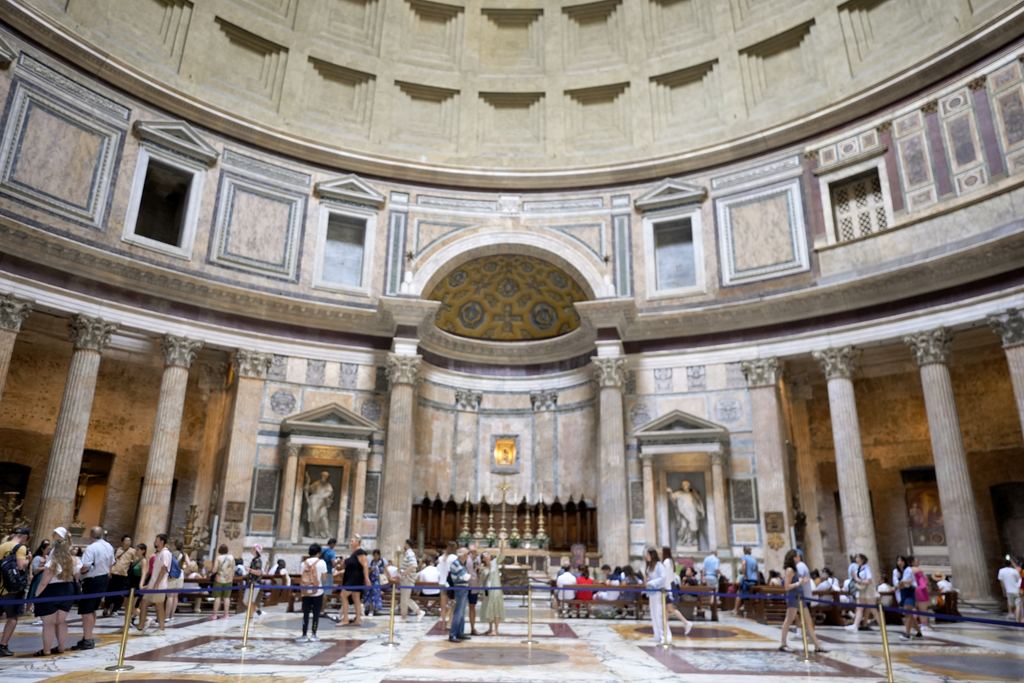
Where to stand
In autumn, turn round and look back at the door
In summer everyone looks down and forward, towards the floor near the entrance. In autumn that instinct is wrong. The sun is in the south, so the light lands on the north side of the room, which is the entrance wall, above and around the bronze door.
Walk in, carry on to the far side near the apse, then turn and look back over the doorway you came through. The patch sits higher than people expect and it is easy to miss altogether if you are scanning the pavement out of habit.
A cloudy day gives you nothing. There is no artificial lighting to fall back on, which is the other thing nobody mentions when they tell you the Pantheon is worth an hour.
25 October, when the hour goes back and the doors start closing after dark
On 24 October the sun sets over Rome at 18:15. On the 25th it sets at 17:13. Nothing has happened in the sky. The clocks went back at three in the morning and took the evening with them.
The monument keeps the same hours all year, 9:00 to 19:00, with the last admission at 18:30, as the Ministry of Culture publishes on its own page for the building. In September that still means closing in daylight, barely: the sun sets at 19:05 today and at 18:58 on 27 September, and from that Sunday until the spring the doors shut after dark. Once the clocks change, anything from about a quarter past five onwards is a night visit, which alters what you are paying for. No beam, no shadows travelling across the coffers, just the shape of the place and the hole in the roof. The calendar version of all this is on opening hours and closures, and if you want daylight outdoors afterwards, the sunset walks around the quarter begin about when the monument stops being interesting.
The Pantheon oculus equinox, and a date less special than it sounds
The September equinox falls at 02:05 Rome time today, 23 September. Inside the building nothing marks it. The disc is 19.4 m up the entrance wall, it will be slightly higher tomorrow, and it was slightly lower yesterday. There is no alignment and no moment to turn up for. An equinox is a fact about the Earth's axis, not about this room.
What the arithmetic does produce is a mirror. Today's position on the wall is within a metre of where the disc sits in the third week of March, and the same symmetry holds either side of the solstice: on 21 April the centre of the disc crosses the great doorway at 5.9 m above the floor, and on 21 August at 5.6 m. That symmetry is the strongest objection to the best story told about this building.
In 2011 Robert Hannah and Giulio Magli argued in Numen that the April alignment was designed, with an emperor walking in through the sunlight on Rome's traditional birthday. The beam itself is real and anyone can reproduce it; we just have. Whether it was intended is a hypothesis, and the authors are careful about that: they state plainly that they are not claiming the building was made to measure the sun. Eugenio La Rocca reached a similar reading of April independently, then pulled back from it, calling sundial interpretations of the rotunda more than the evidence will carry. The standard Cambridge volume on the monument leaves the theory alone. And the sky cannot break the tie, because the sun stands at the same height over Rome in the third week of August as it does on 21 April. The full month by month calculation is on where the light falls.
And yes, the rain comes in
This is the season the question starts to matter, and the answer is not the one you will hear in the square. Warm air rising through the opening does sometimes break up a light drizzle. It does not keep the weather out. The most direct source on that is the basilica that holds services in the building.
The most famous—and false—legend claims that the rain never enters the building.
Water lands on the marble and drains away underneath it. The historical argument is blunter than the physics. Giacomo della Porta in 1591, Alexander VII in 1660 and James Gibbs in the eighteenth century all worked on schemes to close the oculus, and in 1880 a proposal for a tomb in the middle of the floor was refused partly because the ancient drains below would not have coped. Three centuries of expensive worry about plumbing is not the signature of a building that stays dry.
| 1 | 2 | 3 | 4 | 5 | 6 | 7 | 8 | 9 | 10 | 11 | 12 |
Questions about the light in autumn
Where does the light from the Pantheon's oculus fall in autumn?
On the entrance wall through September, then on the dome from the first days of October. On 23 September the centre of the disc is about 19.4 m above the floor; by the December solstice it has climbed to 35.8 m, close under the opening. It only reaches the pavement between early May and mid August.
What time does the sunbeam cross the Pantheon?
Between 12:50 and 12:40 while summer time lasts, drifting earlier through October, and between 11:38 and 11:50 from 28 October to the solstice. Not noon, ever. Italian clocks are anchored to a meridian east of Rome, summer time adds an hour until 25 October, and the building is turned about 4.4 degrees west of north, which brings the crossing forward by roughly ten minutes.
Does anything happen inside the Pantheon at the equinox?
No. The equinox is a fact about the Earth's orbit and the geometry of this room does not mark it. On 23 September 2026 the disc is 19.4 m up the entrance wall, a little higher than the day before and a little lower than the day after. If you want a date when the light does something visible, the third weeks of April and August are when it crosses the doorway.
Is autumn a good time to come for the light?
It depends what you want to see. The disc never touches the floor, so the photograph everybody knows is off the table until May. What you get instead is the patch travelling across the coffers, which changes while you watch it, and a quieter room at the hours when the light is worth looking at. A cloudy day gives you nothing at all in any season.
When does it get dark in Rome in October?
Sunset falls at 18:52 on 1 October and 18:15 on 24 October. The clocks go back on 25 October, when sunset lands at 17:13, and by the 31st it is 17:05. The monument still closes at 19:00 with last admission at 18:30, so after the clock change the final hour and a half of the day is spent in a dark building.
Does rain come through the oculus?
Yes. The basilica calls the idea that it does not the most famous and false legend about the building, and says the water falls onto the marble and drains away. Four centuries of papal schemes to close the opening make the same point from the other direction.
The whole year, calculated
Every month, the time the beam crosses the axis, the height it strikes, and how much of the April theory survives contact with the arithmetic.
Going in with someone who knows the building
Archaeologists and art historians run these. If you want the dome and the oculus explained while you are standing under them, this is the branch of the catalogue that does it.
Best of Rome Private Walk with Pantheon and Trevi Tickets
Two booked entries rather than one: inside the Pantheon, and down at the Trevi basin, where access is now controlled and a slot decides where you stand.

From the Capuchin Crypt to the Pantheon, Ending Inside the Rotunda
From a room of arranged bones to the calmest interior in Rome, in that order on purpose, finishing inside the rotunda rather than in the square.
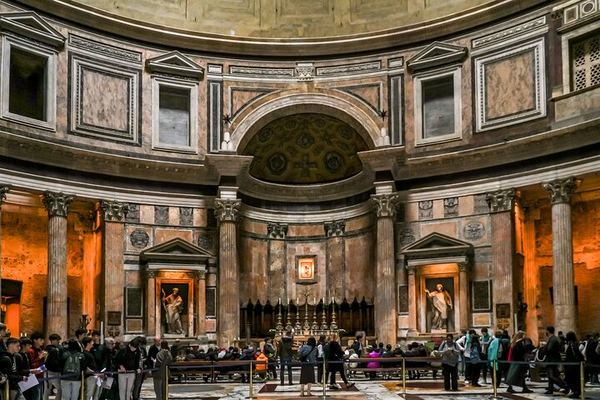
Pantheon Guided Tour in 45 Minutes, with the Chapels and the Tombs
A tour specific about what it shows: two named chapels, the statues of Jupiter, Venus and Mars, and the tombs including Queen Margherita's.
Ratings collected by Viator and Tripadvisor
Data verified on. Sun positions computed with the NOAA algorithm for 41.8986 N, 12.4767 E. Opening hours from the Ministry of Culture's page for the monument, read on 2 September 2026.

