
The Capuchin Crypt and Rome's burial places: tours from the centre
The bones of about 3,700 friars, arranged by the men who buried them. It is twenty minutes from the Pantheon, it costs €10, and it was not built to be creepy.
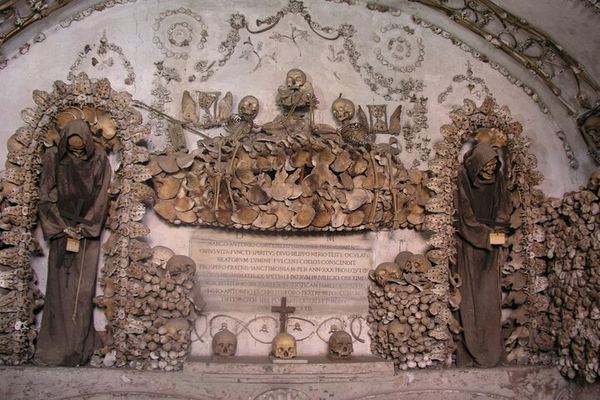
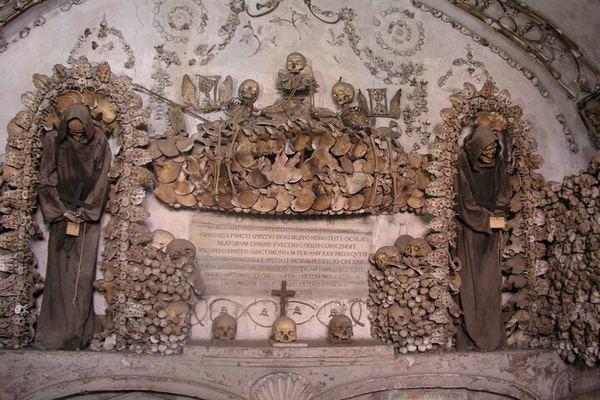
Under a church on Via Veneto, six small rooms are decorated with the bones of roughly three thousand seven hundred Capuchin friars. Vertebrae as rosettes, pelvises as wings, whole skeletons in habits standing in niches. It is twenty minutes' walk from the Pantheon and it is on almost every dark-side-of-Rome itinerary sold in this city.
Almost all of those itineraries get the tone wrong, and one of them gets the building wrong. It is worth setting both straight before you book.
Ten products here, from €37 to €635, median €72,40, rating 4.89 across 376 reviews. This and the self-guided page are the two thinnest lists on the site, and in both cases what you are looking at is the whole market rather than a selection.
Two corrections before the list. The number is 3,700, not 4,000 — the museum publishes the lower figure and the higher one comes from a source that contradicts itself. And the crypt closes at 18:30, so an evening ghost tour promising you a bone chapel is promising a different building.
Capuchin Crypts and the Dark Centre, Group of Fifteen
Does not end at the crypt exit: the walk continues through the centre. Shoulders and knees must be covered; cover-ups cost a euro at the door.
Caravaggio in Rome and the Capuchin Crypt, Ten People Maximum
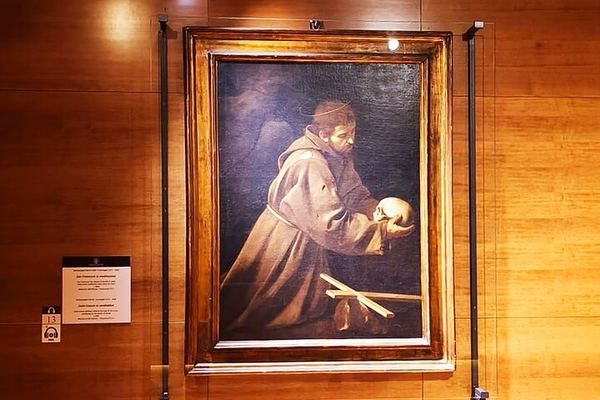
Three Caravaggios at San Luigi dei Francesi, then a crypt decorated with the bones of the friars who lived there. A small group is what makes it work.
Catacombs and City Highlights, Privately with a Driver
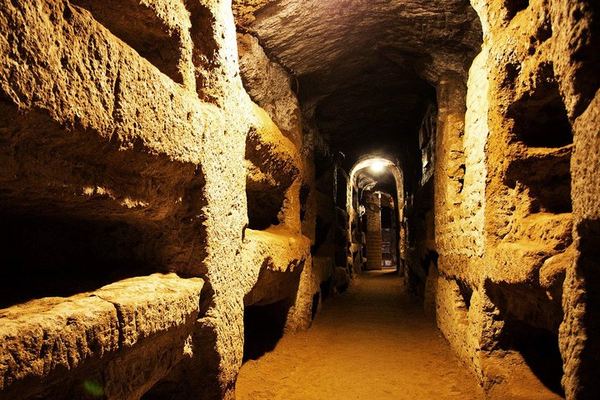
The car earns its place in the afternoon: the catacombs lie well outside the walls, and the site's own guide is included. Lunch built in.
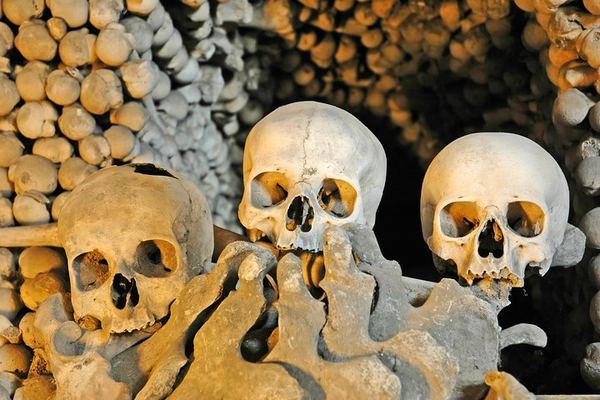
Crypts and Legends, from Piazza Barberini to Via Giulia
Opens with the bone chapels under Via Veneto and closes at the confraternity church that collected unclaimed bodies from the streets.
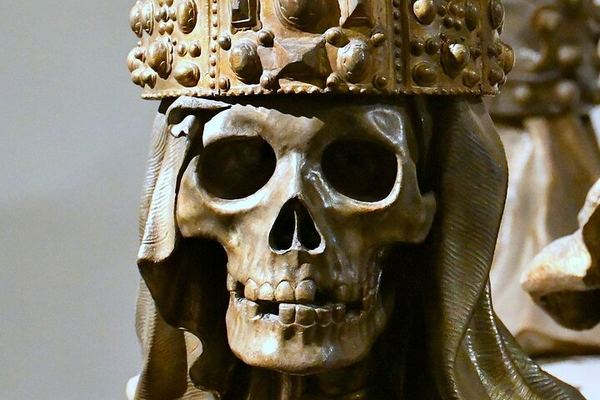
From the Capuchin Crypt to the Pantheon, Ending Inside the Rotunda
From a room of arranged bones to the calmest interior in Rome, in that order on purpose, finishing inside the rotunda rather than in the square.
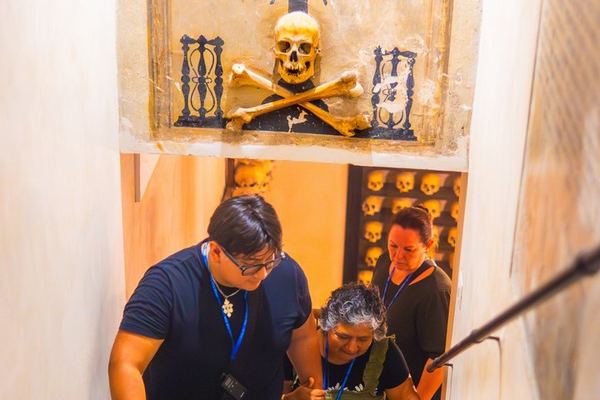
Inside the Confraternity of Death, Opened by Appointment
A church shut for over a decade, unlocked by the confraternity's own nun, with bone chandeliers and named skulls in the crypt below.
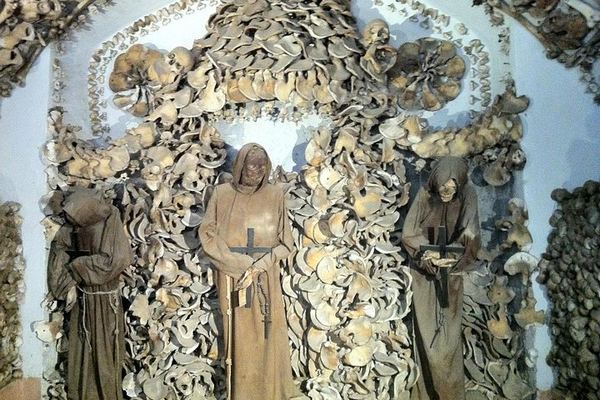
Private Underground Rome: Stadium, Bone Crypt, City of Water
Three sites below street level with one guide, including the chapels built from the bones of some 3,700 friars. Check the Navona site is open.
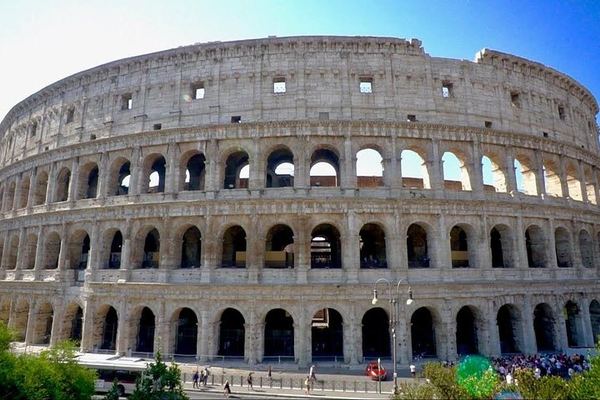
Rome in a Day by Car, with the Catacombs and the Appian Way
The afternoon leaves the centre for the second-century burial galleries and the original basalt paving of the oldest Roman road.
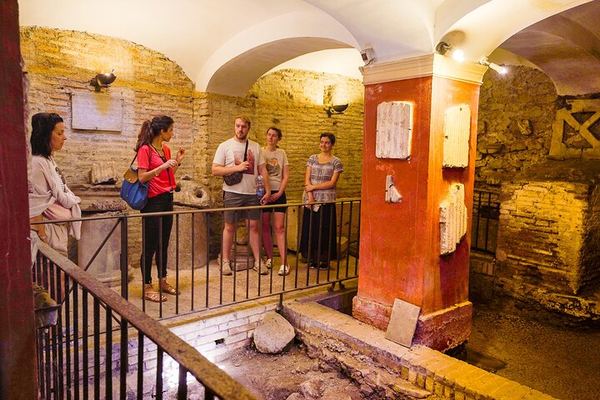
Trastevere and the Ghetto, with a Crypt Five Metres Down
The nuns of Santa Cecilia open the level five metres below the street, and a Bernini in an empty side chapel has no queue in front of it.
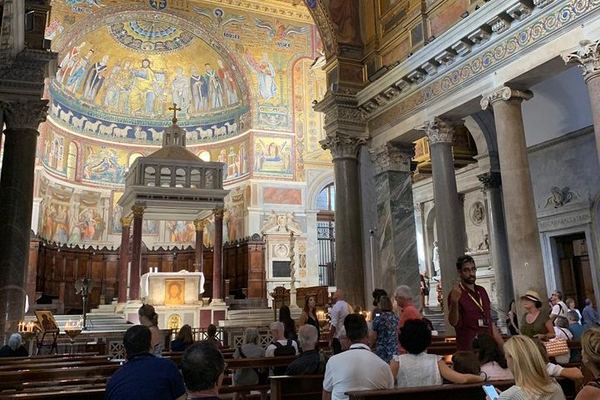
Villa Farnesina and Trastevere, Privately
Starts inside the villa Raphael painted for a banker who threw the dinner plates in the Tiber, then works through the district on foot.
Ratings collected by Viator and Tripadvisor
It was built as an argument, not as a spectacle
The friars moved to this site on 16 April 1631 and brought the remains of their brothers with them from their previous convent. Soil was carried from the Holy Land and laid in the crypt so that the dead would rest in it. Burials continued until 1870.
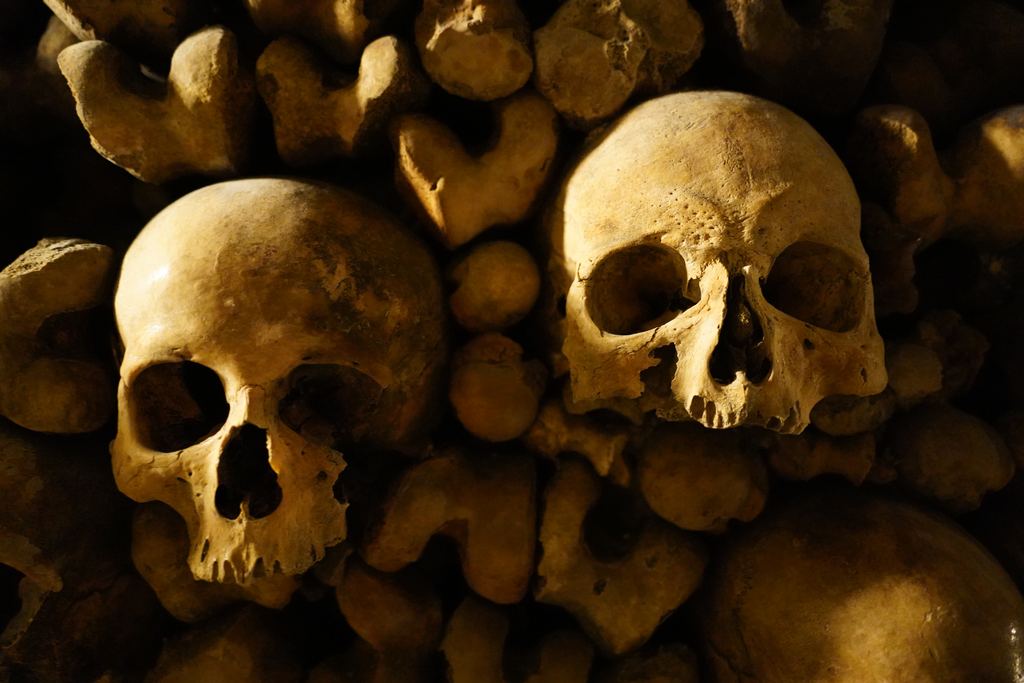
The arrangement is not a Victorian folly and it is not gothic decoration. It is a Capuchin sermon in a Capuchin idiom: the order was founded on poverty and on a plain confrontation with death, and the crypt says one thing to anyone standing in it. There is a plaque at the end that says it directly, and the epitaph of the cardinal who founded the church says the same in five words: here lies dust, ash and nothing.
The order does not describe the place as macabre. Visitors do, and the market sells it that way, and both of those are fair reactions to a room made of pelvises. But knowing what it was for changes what you see, and a good guide will begin with that rather than with a ghost story.
| Room | What is in it |
|---|---|
| Crypt of the Resurrection | A framed picture of Lazarus, surrounded by bones set into the wall |
| Mass Chapel | The only one without bones on the walls. Still used |
| Crypt of the Skulls | Skulls stacked and set in arches, with two standing skeletons in habits |
| Crypt of the Pelvises | Pelvic bones used as a decorative motif across the ceiling and walls |
| Crypt of the Leg Bones and Thigh Bones | Femurs and tibias laid in patterns, the largest of the rooms |
| Crypt of the Three Skeletons | Three complete skeletons, one holding a scythe and a scale, and the plaque with the message |
The visitors who wrote it down
De Sade, Hawthorne and Mark Twain all came
This is not a recent tourist attraction. The Marquis de Sade visited in 1775. Nathaniel Hawthorne put it into The Marble Faun in 1860. Mark Twain came in the summer of 1867 and described it at length in The Innocents Abroad, two years later.
Twain's account is the one worth reading before you go, partly because it is very funny and partly because his reaction — half revolted, half impressed, entirely unable to look away — is still exactly what happens to people in the third room.
Upstairs, the church has a Guido Reni archangel from the mid-1630s, a Mocking of Christ by Honthorst and an Ecstasy of Saint Francis by Domenichino. Almost nobody goes up. It is free.
What you are now, we once were. What we are now, you will be.
Ten euro, and what the tours add
The ticket is €10,00, with an audio guide included. Reduced is €6,50 for 7 to 17 year olds, over-65s, students, international guides, Catholic religious and FAI members. Children up to six go free, as do disabled visitors with a companion and Italian licensed guides with a badge. Buying online adds €1,50 a ticket.
It opens every day, from 09:30 to 13:30 with last entry at 12:30, and again from 14:30 to 18:30 with last entry at 17:30. It closes on Easter Sunday, 25 December and 1 January, and runs short hours on Holy Saturday, 2 November and the two New Year's Eves.
No city pass works here. Not the Roma Pass, not the MIC card, not ICOM, not the Turbo Pass. This catches people out constantly and it is stated plainly on the museum's own site, where almost nobody looks.
So the arithmetic on this page is simple: a €37 tour is a €10 ticket and €27 of guiding and walking. That is fair. What is less well known is that the museum runs its own guided visits — €90 for the group, plus tickets, booked at least a week ahead, headsets compulsory, maximum ten people. For a party of ten that works out at about €19 a head all in, which is half the cheapest thing on this page and comes with somebody who works there.
The other crypt people mean
There is a second bone chapel in Rome and the two get confused, including by at least one large marketplace's own category page.
Santa Maria dell'Orazione e Morte, on Via Giulia, belonged to a confraternity whose work was recovering and burying unclaimed bodies. Its underground chambers are decorated with bones too. It is eleven minutes from the Pantheon rather than twenty, and it is the one that appears on evening itineraries, because the Capuchin crypt shuts at 18:30 and cannot.
If a night tour promises you a chapel decorated with human bones, this is what you are going to see. It is a genuine and interesting place. It is not the Capuchin crypt, and the pictures in the listing usually are.
The rules, and the ones that are not written down
Photography is not permitted in the crypt. This is enforced, and it is the source of most of the friction at the entrance. It is a burial place belonging to a religious order, not a set.
There is a dress code: shoulders and knees covered, as in any Roman church. In August this catches out at least one person in every group.
Groups over twenty-five are split, and the museum's own guided visits cap at ten with headsets. The corridor is about thirty metres long and quite narrow; the practical constraint is the space, not the policy.
And one that is not a rule but ought to be. It is a working church above and a cemetery below, and the friars are still there. Whatever the tour is called, the appropriate volume in the last three rooms is quiet.
Who should skip it
We would rather say this than have you find out at the bottom of the stairs.
The rooms are small, low and underground, reached by a staircase. Anyone who finds enclosed spaces difficult should think twice. There is no way around the subject matter: it is thousands of human bones, arranged deliberately, at arm's length, in artificial light.
With children, the museum sets no minimum age and admits under-sevens free, so it is a judgement rather than a rule. Some eight-year-olds find it the best thing in Rome. Some adults leave after two rooms.
And if you are grieving, this is not the week. It is a beautiful and serious place and it makes an argument about mortality with no gentleness whatsoever. That is the point of it.
Before visiting the crypt
How many bodies are in the Capuchin Crypt?
About 3,700, according to the museum itself. The figure of 4,000 circulates widely, including on a page that gives both numbers a few paragraphs apart. Most are Capuchin friars; the burials span roughly three and a half centuries and stopped in 1870.
How much does it cost?
€10,00 full, €6,50 reduced, with an audio guide included and €1,50 added for booking online. It takes no city passes at all — not the Roma Pass, not the MIC card, not ICOM. Several aggregators quote €42 or more, which are tour prices with the ticket inside them.
Can I visit it in the evening?
No. Last entry is 17:30 and it closes at 18:30, every day. Any evening tour that promises a bone chapel is taking you to Santa Maria dell'Orazione e Morte on Via Giulia, which is a different place with a similar decorative logic.
Can I take photographs?
No, and it is enforced. It is a burial place belonging to a religious order. The audio guide included with the ticket is the substitute, and the church upstairs, where photography rules are the ordinary church ones, has a Guido Reni in the first chapel on the right.
Is it far from the Pantheon?
Twenty minutes on foot, north-east, up towards Via Veneto. It is the furthest thing on this whole site apart from Santa Maria del Popolo. There is no efficient way to combine it with the Pantheon in the same hour, which is why the tours here run two hours or more.
Is it suitable for children?
Under-sevens are free and there is no minimum age, so it is your call rather than the museum's. It is small, quiet and quickly done, which helps. It is also thousands of human bones at close range, which is the whole of the objection and the whole of the point.
The stories that go with it
Twenty-one tours of Rome's crimes, hauntings and the Angels and Demons trail, with what the record actually says about each.
Angels and Demons Privately: Sorting the Novel from the Record
The Bavarian Illuminati postdate Bernini by a century, and what actually happened between the artists and the Church is stranger. Hotel pick-up.
Angels and Demons Tour: the Altars, the Pantheon and the Castle
The novel's trail walked with a guide who separates Brown's invention from the record, including which of the four altars is not by Bernini at all.
Combo: The Bone Crypts and the Dark Side, Two Hours Each
Two walks at a reduced price, taken on one evening with a break or on separate nights. The operator calls you to confirm which.
Ratings collected by Viator and Tripadvisor
The excavated version of underground
Two Roman sites under the streets between the Pantheon and Trevi, one of them nine metres down and one of them currently closed.
Data verified on. Prices, hours, the 3,700 figure, the pass exclusions and the museum's own guided visits are from the Museo e Cripta dei Cappuccini. Church works and dates from the same source.