
How Far in Advance Can You Book the Pantheon in Rome? About Six Weeks
You cannot book the Pantheon in Rome three months out. The calendar is drawn up one month at a time and the slots appear around the middle of the month before, so the real horizon is about six weeks. An empty calendar usually means an unopened month, not a sold-out one.

How far in advance can you book the Pantheon in Rome? About six weeks, and the ceiling is not ours. The monument's visiting calendar is drawn up one month at a time, and the slots for any given month go on sale around the middle of the month before. Search in January for a Tuesday afternoon in April and the calendar gives you nothing at all.
Nothing is not sold out. Nothing is a month that has not been written yet, and the gap between those two readings is the whole subject of this page.
It is a small rule with an expensive consequence. A traveller who reads an empty calendar as a full one goes looking for someone who does show April, finds one in about four seconds, and pays two or three times the state's €7 for a date that nobody can be holding yet. Last week we set out the four sellers at this monument who all call themselves official. This is the mechanism that sends people to the wrong one.
How far in advance the Pantheon in Rome lets you book
Admission is run by the Italian Ministry of Culture, and its page for the monument puts the rule in a single line: the visiting calendar is defined on a monthly basis, and tickets are put on sale in the middle of the previous month. That is the entire mechanism. No rolling ninety-day window, no annual calendar, no early access for anyone.
Around that rule sit the fixed parts of the day, all of them published:
- The monument is open 9:00 to 19:00. Ticket desks close at 18:00 and the last entry is 18:30, with groups and school parties stopping at 18:00.
- Entry runs in nine timed bands between 9:00 and 18:00, with a ceiling of 1,200 people in each.
- Admission is €7, €2 for EU citizens aged 18 to 25, free under 18. No presale right applies on the state channel, so €7 is €7.
- You may buy 25 tickets in one transaction, once per user per band. That limit is written for parties, not for individuals.
- The channels are the Musei Italiani portal and its app, plus the desks and machines at the monument. Payment on the portal runs through PagoPA.
Now the honest gap, because it is the first thing anyone wants after reading the rule. The Ministry publishes the rule and not a release day. "The middle of the previous month" is as precise as the published text gets. Booking guides fill the silence with specific dates, one of them puts the release between the 16th and the 18th, and none of them cites a ministerial source for it. So we are not going to publish a day either. Start looking from around the 15th, and look again two or three days later if the month you want has not appeared.
When Pantheon tickets go on sale, month by month
The rule turns into a calendar of its own. Read the row for the month you are travelling in, and the second column is the week your dates stop being hypothetical.
| Visiting in | The calendar for it opens around | Also true of that month |
|---|---|---|
| January | mid-December | The monument is closed on 1 January |
| February | mid-January | Nothing specific on the calendar |
| March | mid-February | Nothing specific on the calendar |
| April | mid-March | Lazio's museums peak in April, competing with Italian school parties for the same bands |
| May | mid-April | Nothing specific on the calendar |
| June | mid-May | Nothing specific on the calendar |
| July | mid-June | The quietest month for Lazio's museums, the opposite of Rome's arrivals curve |
| August | mid-July | Evening openings are announced year by year, never guaranteed in advance |
| September | mid-August | Nothing specific on the calendar |
| October | mid-September | Nothing specific on the calendar |
| November | mid-October | The first Sunday is free, and free days are not bookable online |
| December | mid-November | The monument is closed on 25 December |

A booking page that offers you a date five months out
Put the two facts side by side. The state's calendar for a month opens around the middle of the month before. A reseller's booking box will happily take a date in March for a visit in August.
Both things are true, and the second is not automatically a swindle. What it cannot be is a ticket. On the day you pay, no state ticket exists for that date, because the calendar carrying it has not been drawn up. What you are buying is a promise that somebody will obtain one once it has, with whatever service sits on top: a host at a meeting point, a recorded commentary, a band chosen for you.
That promise is worth real money to some travellers, particularly ones arriving on a tight schedule. Ask three things before paying, all the same.
- Whose name goes on the ticket? The state ticket is nominative and the document is checked at the door. If a checkout never asks for the names of the people going in, ask when it will.
- What happens if the band you were promised never appears? Read the cancellation terms rather than the headline.
- What is actually in the basket? The inclusions line is the only part of a product page that tells you whether admission is in there at all.
And one sentence from the Ministry, in its own wording rather than ours: buying from unofficial resellers may not allow entry. That warning is worth more than any reassurance printed on a sales page.
An empty calendar is the most misread signal at this monument. For most of the year it does not mean the slots have gone. It means the month has not opened.
While we are at the door, one claim that travels with the booking confusion: skip-the-line entry at the Pantheon does not exist, and the ministerial page says so in English, in as many words. There is no priority lane on sale. What there is, is three separate queues at the entrance, moving at very different speeds, and the quickest of the three is the one nobody advertises. We took the whole claim apart in an earlier piece on the ten ticket sites out of twelve that sell it anyway.

Nominative, and checked
The ticket carries your name, and the door reads it
A Pantheon ticket is issued to a named person, and the document is checked on the way in. A name that does not match the document means no entry, whoever sold the ticket.
Since 10 March 2026 that name can be changed, once, and no later than 72 hours before the booked band. One change, not one per traveller, and the clock is on the slot rather than on the purchase. If three of you are going in and the booking carries one name for all three, that is a problem to solve three days out, not at the portico.
It is also why the six-week rule and the nominative rule work together. A ticket bought five months ahead through an intermediary has to acquire your name at some point between the sale and the visit. Find out when that happens before you pay, not after.
Free entry is a price, not a way round the calendar
Plenty of people pay nothing at the Pantheon. Under-18s, residents of the Comune di Roma, EU citizens aged 18 to 25 at the reduced €2, teachers and university students in architecture, archaeology, art history, cultural heritage and education, EU tourist guides at work, a disabled visitor with a companion. Anyone, during Mass, which is at 17:00 on Saturdays and the eves of feast days and 10:30 on Sundays and feast days. Everyone, on the first Sunday of the month.
Families read "children go free" and hear "children do not need a booking". Those are different sentences, and the second one is not published anywhere we can find.
Here is what is published, and where it stops. The first Sunday of the month is free and explicitly not bookable online: on that day there is no reservation for anyone and the monument runs on a single queue. For every other day, the Ministry publishes who pays nothing and does not publish whether a visitor who pays nothing still occupies a slot. We are not going to invent the answer. Our reading, stated as a reading: the ceiling of 1,200 per band is a ceiling on people, not on paying people, so plan on everyone in the party needing a place in the same band, and book the whole party in one transaction while the month is open.
What the same ticket costs once somebody else books it for you
Our own catalogue is a decent mirror of the market, so here are its numbers, read on 14 October 2026. Fourteen English-language entry-ticket listings for the Pantheon. The median price is €9.45 against the state's €7, and the range runs from €4.70 to €18.00.
Two of the fourteen are priced below the state's own admission, which is the same oddity we flagged last week: a listing under €7 cannot contain a full-price adult ticket with a service on top of it. Either the price in the feed predates the July increase or the product is the service without the entry. The inclusions line settles it, and nothing else on the page does.
Look at the ratings too. They are the quietest argument in this article. Those fourteen listings carry 4,430 reviews between them. The arithmetic average of their scores is 4.4; weighted by how many people actually left a review, it is 4.2. The gap is one listing with 1,981 reviews sitting at 4.0, and it is the kind of detail a star rating on a card is designed to smooth over. Buying the service of being booked in is not a guarantee of a better morning.
If you miss your time slot
There is no published rule. We looked, and there is nothing from the Ministry on what happens to a visitor who arrives at 11:40 on an 11:00 ticket. In practice it depends on who is at the door and how the bands are running, and any site that tells you confidently otherwise is guessing in public.
What can be said with a source behind it is the fallback. Three queues form at the entrance: cash on the left, card machines on the other side, booked entries in the middle. Direct accounts put the cash queue at five to fifteen minutes even in high season, while the card queue is the long one. If a slot is lost and the day is not a first Sunday, buying again with cash is usually faster than arguing. Two warnings on that: the ticket desks shut at 18:00, an hour before the monument does, and nothing here applies to a free day, when nobody is buying anything.
So how far in advance should you book the Pantheon in Rome?
The honest answer has two halves, and only one of them is a number.
The hard half is the ceiling: you cannot book earlier than the middle of the month before, however organised you are. That makes the Pantheon the odd item in a Rome itinerary. Flights and hotels are chosen months out, and this is a monument whose inventory appears about six weeks before the visit and can be bought at the door on the day. Nobody needs to plan a trip around it. Plenty of people worry about it anyway, because every other line of the itinerary rewards booking early.
The soft half is how quickly bands fill once the month opens, and we are not going to publish a figure for it, because nobody publishes the data and a number invented here would be exactly the sort of thing this site exists to contradict. What is documented is the shape of the problem: nine bands, 1,200 places in each, and one round room that every one of those people walks into. If a specific morning band matters, buy it the week the month opens. If any time will do, the door is a real option.
Three timing rules sit outside the six-week window and are easy to miss:
- Beyond the Pantheon, the 45-minute visit to the spaces behind the rotunda, costs €10 on top of the €7 and must be booked at least four days ahead. It does not run on the first Sunday of the month.
- Groups above six people need radioguides or a whisper system. The group ticket covers 10 to 26 people and requires a licensed guide, and there are no group slots after 18:00.
- The Pantheon is in neither the Roma Pass nor the Omnia circuit, so a city pass bought in advance buys nothing here. Our page on tickets and prices keeps the full list, with the date each figure was checked.
Questions about booking the Pantheon in Rome
How far in advance can you book Pantheon tickets in Rome?
About six weeks. The visiting calendar is drawn up on a monthly basis and the slots for a month go on sale around the middle of the month before, so a date further out than that cannot be booked by anybody, through any channel. If a page offers you one, it is selling a promise to obtain a ticket later, not the ticket.
When do Pantheon tickets go on sale each month?
Around the middle of the previous month. The Ministry of Culture publishes the rule but not a fixed release day, so there is no official date to diary. Looking from about the 15th and again a few days later covers it. For a visit in December, that means watching from around 15 November.
Why does the Pantheon booking page show no availability?
Most often because the month has not been released yet rather than because it is full. Check which month you are looking at: if it is more than roughly six weeks away, there is nothing there to be sold out. If your date is inside the window and the bands really are gone, the ticket desks at the monument still sell for the same day, and there is a free first Sunday every month that nobody can book in advance.
Can you buy Pantheon tickets on the day in Rome?
Yes. Desks and machines at the monument sell admission on the day, which is why the six-week limit matters less than it looks. Three queues form at the entrance and they move at very different speeds: direct accounts put the cash queue at five to fifteen minutes even in high season, while the card queue is the long one. The desks close at 18:00, half an hour before the last entry.
Is the Pantheon ticket in my name, and can I change it?
It is nominative, and the document is checked at the entrance. Since 10 March 2026 the name can be changed once and no later than 72 hours before the booked band. A name that does not match the document means no entry, so the names have to be right at the point of purchase, including on anything bought through an intermediary.
Do children and other free visitors still need to book a slot?
The Ministry publishes who pays nothing and does not publish whether a free visitor needs a reservation on an ordinary day, so we will not state one. The safe reading is that the ceiling of 1,200 per band counts people rather than payments: book the whole party, free places included, in a single transaction while the month is open. The exception is published and absolute, the first Sunday of the month is free and has no online booking at all, for anybody.
The booking routes, side by side
Which door asks for what, what each adds to the €7, and which of them can see six weeks out.
Entry tickets that do not promise a lane that does not exist
The four most reviewed English entry-ticket listings in our catalogue that advertise no priority entry at the Pantheon. All of them buy you the same admission the state sells at €7, with a service attached. Read the inclusions line before paying.

Pantheon Ticket with Piazza della Rotonda and the Minerva Elephant
Three stops rather than one: the square facing the portico, the rotunda itself, then Bernini's marble elephant beside Rome's only Gothic church.
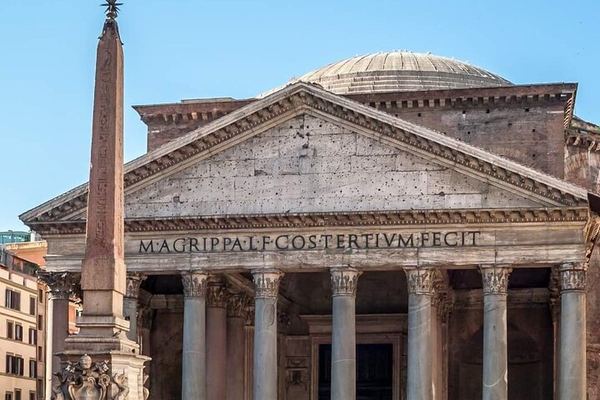
Pantheon Reserved Entry and Audio, Ticket Handed Over at Piazza della Minerva
The ticket is bought on your behalf and sent by email or WhatsApp, then handed over in Piazza della Minerva ten minutes before your chosen entry time.
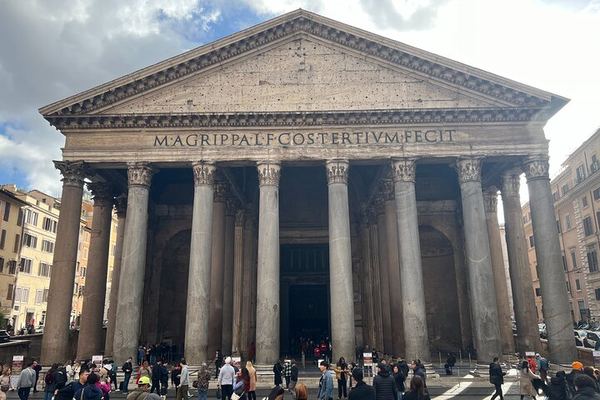
Pantheon Entry Ticket with a Time Slot You Choose
Entry is fixed to the time window you pick, and nothing after it is: no guide, no group and no set route through the rotunda once you are through the door.

Pantheon Entry Ticket with a Host at Piazza Capranica and a Phone Audio Guide
A host with a white flag meets you in Piazza Capranica and walks you through the door; from there the audio guide runs on your own phone at your own pace.
Ratings collected by Viator and Tripadvisor
Data verified on. Release rule, prices, hours, capacity, nominative ticket: Ministry of Culture page for the Pantheon, read 2 September 2026. Catalogue prices and ratings read 14 October 2026.


