
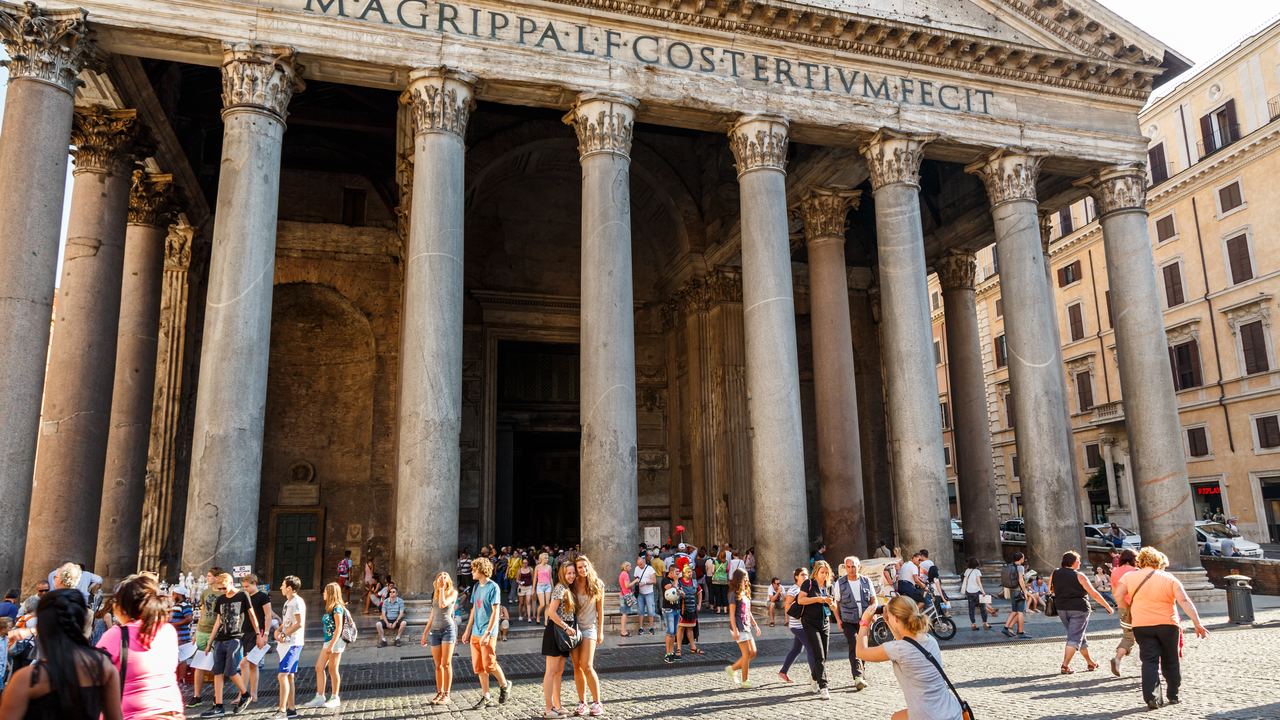
The Pantheon is an unusually easy monument to visit and an unusually easy one to be misled about. It takes half an hour, costs seven euro, needs no booking and has no hidden wing. Almost everything sold as a solution to a Pantheon problem is a solution to a problem this building does not have.
These nine pages set out what is actually true, with the source beside each fact and the date we checked it. If you read only one, make it the one about the three queues, which will save you more time than anything you can buy.
The whole thing, in one table
| Where it is explained | ||
|---|---|---|
| Adult ticket | 7.00 EUR, up from 5.00 on 1 July 2026 | Tickets and prices |
| Reduced, EU 18 to 25 | 2.00 EUR | Tickets and prices |
| Free | Under 18, Rome residents, first Sunday of the month, during Mass | Tickets and prices |
| Roma Pass | Not included. Nor the Omnia card | Questions visitors ask |
| Hours | 9:00 to 19:00 daily, last entry 18:30, desk shuts 18:00 | Opening hours |
| Closed | 25 December and 1 January only | Opening hours |
| Booking | Optional, no fee, calendar about six weeks deep | How to book |
| Skip-the-line | Does not exist. The ministry says so in writing | The three queues |
| Fastest queue | Cash, to the left of the entrance. 5 to 15 minutes | The three queues |
| Ticket | Personal. Identity document checked at the door | How to book |
| Dress code | Shoulders covered. Staff may refuse entry | Access and rules |
| Step-free entry | The ramp on the Via della Minerva side | Access and rules |
| Cloakroom | None | Access and rules |
| Best months | May, and the second half of September | The best time to visit |
The nine pages
Each one answers a single question properly rather than nine of them badly.
Tickets and prices
Seven euro, who gets in free, and the four organisations that will each sell you something called a Pantheon ticket.
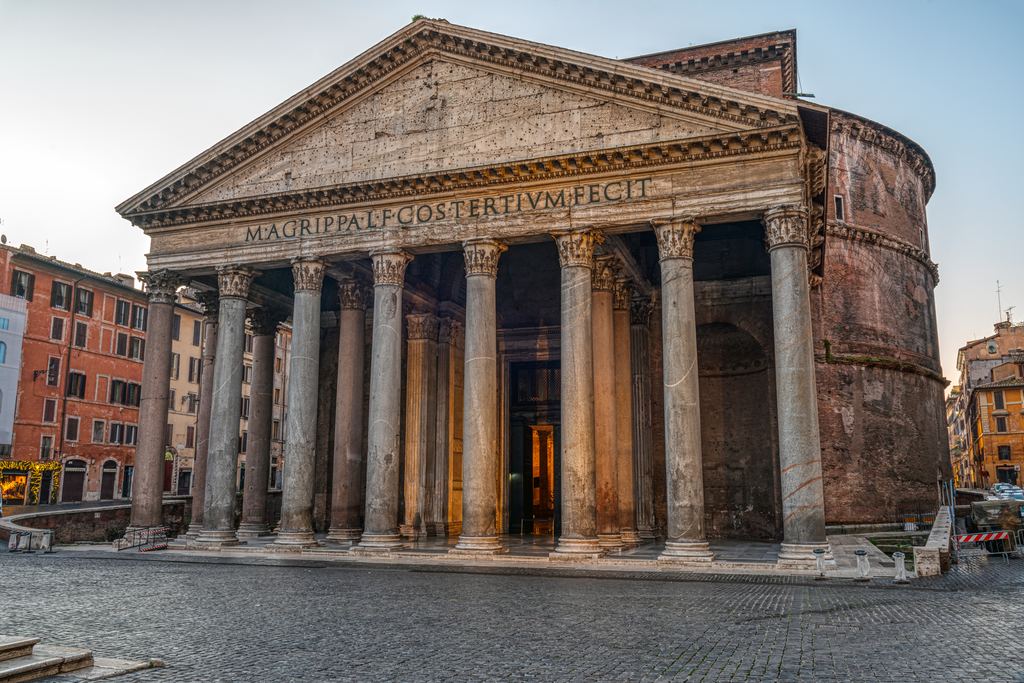
Opening hours and closures
Nine to seven, 363 days a year. The Mass slots, the free Sundays, and why nothing exists more than six weeks ahead.
The three queues
Cash, cards, pre-booked. One of them clears in a quarter of an hour and it is not the one people join.

How to book
Which website is the state, which is the church, which is neither, and what to do when the payment fails.
Access, dress code and rules
The ramp, the scarf, the phone. Twelve competing sites have no page on this at all.

The best time to visit
Rome's museums peak in April and its arrivals in July. Climate normals, crowd curves and daylight.

What to bring
Six things for the building, a longer list for the basalt streets outside, and where the free water is.

How to choose a tour
Of 1,096 experiences sold around the monument, 78 go inside. Four families compared, honestly.

Questions visitors ask
Thirty answers with their sources, including the several where the honest answer is that nobody publishes it.
Five things the rest of the web gets wrong
We read twelve websites built specifically to sell Pantheon tickets, in August 2026. This is not a straw man; it is what the first page of results contains.
The price. Ten of the twelve still print five euro or give no price at all. One had updated its page the month after the increase and left the old figure in place. Another states that entry is free.
Skip-the-line. Ten of the twelve sell it. The ministry states twice on its own page that it is not available. One site markets the on-site cash desk as skip-the-line while listing its wait at forty-five to sixty minutes.
The oculus. Published widths across the field range from about 7.6 to 9.2 metres. One site gives four different figures on four of its own pages. The Cambridge reference gives thirty Roman feet, about nine metres.
The closures. Between them, these sites invent closures on 1 May, 15 August, Epiphany, Easter and 29 June. There are two, and they are Christmas Day and New Year's Day.
Accessibility. Not one of the twelve has a page about it. The ministry publishes the information, in English, and nobody has carried it across.
None of that requires special access or clever research. It requires reading the official page and writing down what it says, with the date.

If you only have ten minutes
The short version
Bring seven euro in notes and a passport or ID card. Join the queue on the left of the entrance. Cover your shoulders. Do not buy a skip-the-line ticket, because there is nothing to skip.
Go early or late if you want the room quiet; go around one o'clock between May and August if you want to see the sunbeam land on the floor. You cannot have both, and the beam is the rarer of the two.
Once you are inside, look up, then look at the floor, then look at the two colours of granite in the portico on your way out. That is the building.
The visit, start to finish
Nine pages is a lot of detail for a building you will be inside for half an hour. Here is the same information as a sequence, in the order it actually happens to you.
You will arrive on foot, and you will not see it coming. There is no metro station near the Pantheon: Spagna is about seventeen minutes away, Barberini twenty, and the useful bus stop is Largo di Torre Argentina, six minutes south. Whichever way you come, you approach through narrow streets that give away nothing, and the portico appears all at once when you turn the last corner into the square. That is a quirk of how medieval Rome grew up against the building, and it is the best thing about arriving here.
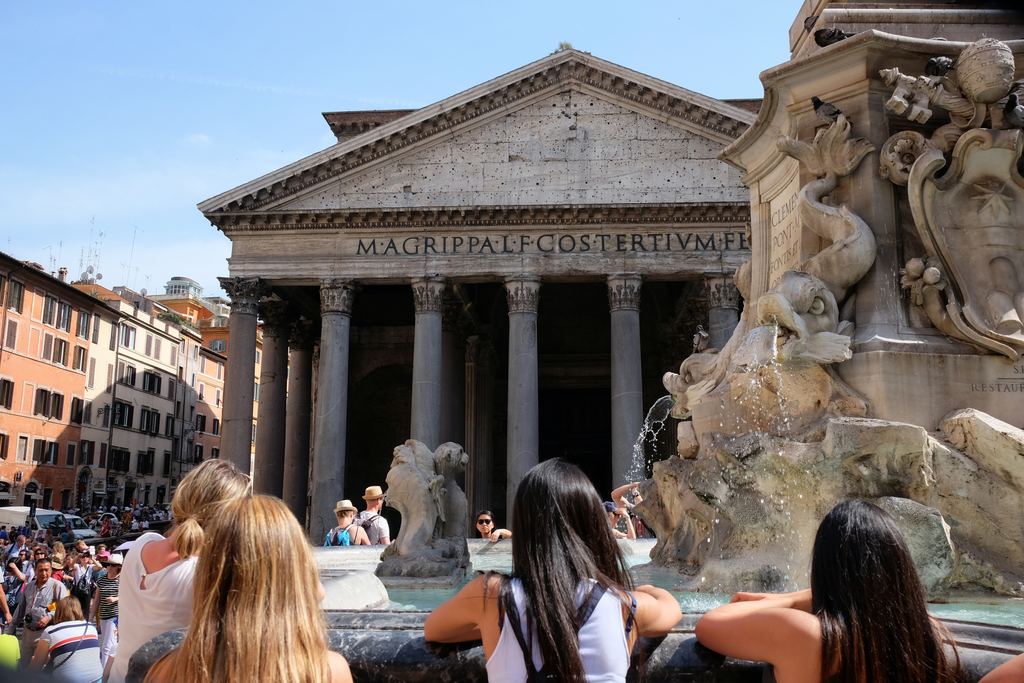
Piazza della Rotonda will be busy, and two things in it are worth knowing apart. The large fountain in the middle, with the Egyptian obelisk on top, is Giacomo della Porta's of 1575; the obelisk was added in 1711. It is not drinking water and using it as such is a finable offence. About eighty-seven metres away there is a nasone, one of Rome's cast-iron street fountains and a rare survivor with three dragon-head spouts, and that one is ordinary mains drinking water, cold and free. Fill your bottle there.
Then you choose a queue, and this is where most people lose twenty minutes. There are three. Cash is to the left of the entrance as you face it, card machines are on the other side, and pre-booked visitors go through the middle. Visitors consistently report the cash line clearing in five to fifteen minutes even in high season, while the machines are much slower. Seven euro a head, in notes, is the whole trick.
At the door they check a document, because the ticket carries your name. They also check what you are wearing: shoulders covered, nothing very short or transparent, and staff are authorised to turn people away. A scarf settles it and weighs nothing. If you need step-free access, do not join any of these queues at all: the ramp is on the Via della Minerva side, round to the left of the building.
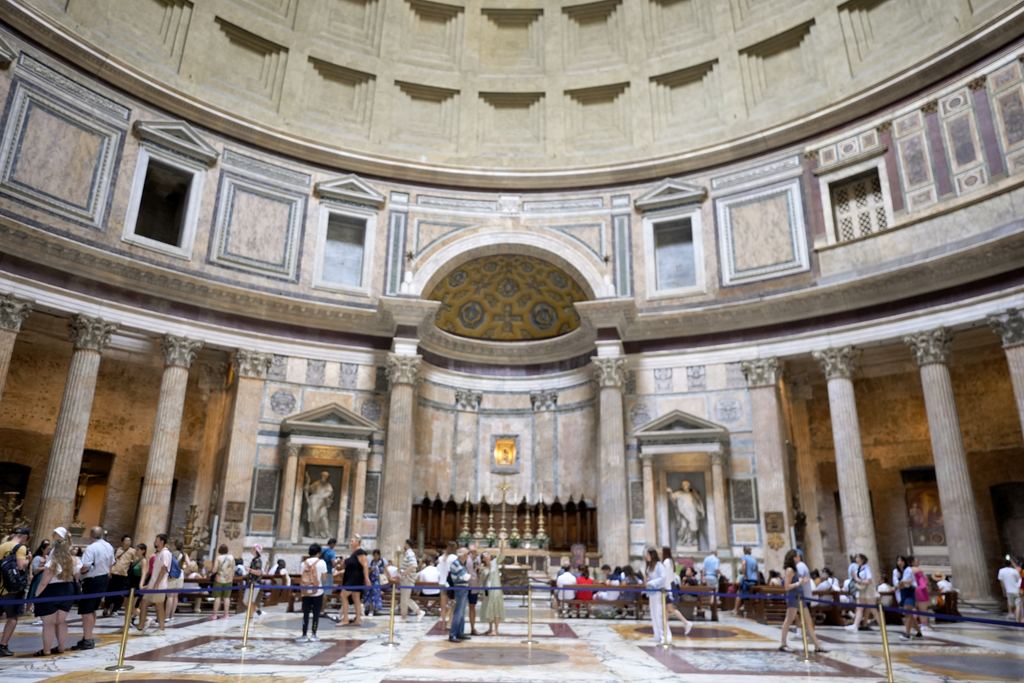
Inside there is no route. This is a single round room, and everything worth seeing is visible from where you are standing when you walk in. Look up first, because that is what the porch was designed to make you do. Then find the disc of sunlight and see where it has landed, which changes every day of the year. Then walk the perimeter for the tombs, which are the part where labels help least and knowing a little helps most.
When you leave, you are two minutes from two free churches. Santa Maria sopra Minerva is directly behind, with Bernini's elephant in the square in front of it and a Michelangelo inside. San Luigi dei Francesi is five minutes the other way and holds three Caravaggios. Neither charges anything, and after a monument that takes half an hour you will have the afternoon.
The five questions people ask before they come
Do I need to book the Pantheon in advance?
No. Booking is optional, there is no fee on the official channel, and tickets are sold on site. A booking fixes your entry hour; it does not shorten the queue, because everyone is document-checked at the same single doorway.
How long should I allow?
Half an hour covers it; an hour rewards you. There is no official recommended duration and no limit on how long you may stay, since the time slot governs entry rather than exit.
Is it worth paying for a guided tour?
For many visitors, no, and we would rather say so on the page that sells them. It is one room and nothing is hidden. A guide earns the fee if you want to ask questions, or want the things you would not know to look for.
What is the one thing most people get wrong?
Buying a skip-the-line ticket. It does not exist here, the ministry says so twice on its own page, and ten of the twelve Pantheon ticket sites we surveyed sell one anyway.
When is the best time to go?
May or the second half of September for the balance of weather and crowds. Early morning or the last two hours for a quiet room. Around one in the afternoon between May and August if you want the sunbeam on the floor, which is also the busiest hour.
Data verified on. Every figure on this page comes from the Direzione Musei nazionali di Roma or cultura.gov.it, except the climate normals (WMO 1991-2020) and the catalogue counts, which we computed ourselves.