
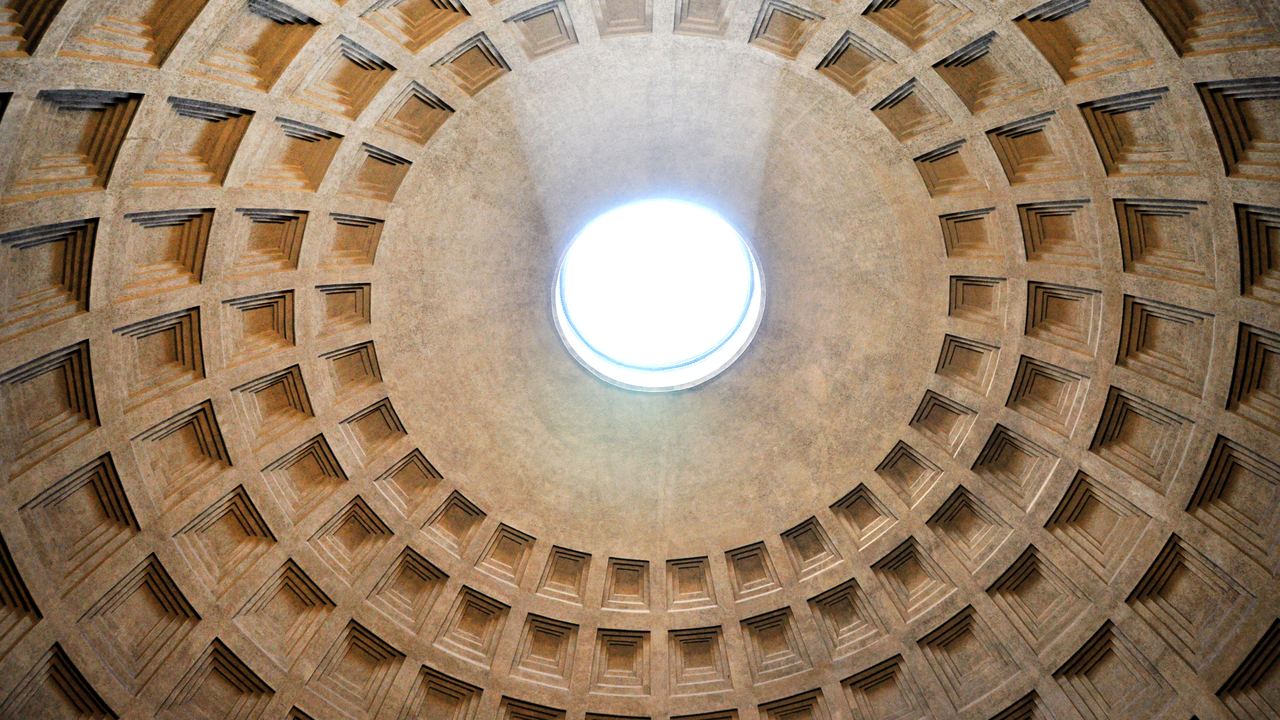
Nineteen centuries after the concrete went off, this is still the largest unreinforced concrete dome in the world. Not the largest Roman one, not the largest of its era. The largest, full stop, of anything ever built without steel in it.
The numbers describing it are printed everywhere and are wrong surprisingly often, including on the website of the basilica that occupies the building. So here they are with their sources, and with the disagreements shown rather than smoothed over.
One number, repeated
The essential fact about the Pantheon's geometry is that it only has one dimension. The interior diameter and the interior height are the same, and the cornice running round the wall cuts that height in half exactly. The dome is the top of a sphere; the bottom of the same sphere would fit precisely into the cylinder holding it up.
Stand in the middle and you are standing at the centre of a ball 43 metres across, half of which is imaginary and half of which is above your head.
| Value | Source, and the caveat | |
|---|---|---|
| Interior diameter | 43.3 m | The figure in general use, and the one we use here |
| Same, by laser survey | 43.56 m | Aung and Bork 2025. A real difference, not a conversion artefact |
| Same, face to face | 43.57 m | Wilson Jones 2000, cited in the Cambridge volume: 147.20 Roman feet |
| Floor to oculus | equal to the diameter | The Cambridge volume states the equality directly |
| Springing of the dome | about 21.7 m | Exactly half. The interior cornice bisects the height |
| Oculus | 30 Roman feet, about 9 m | Cambridge volume, following Pelletti 1989 |
| Oculus, alternative | 8.3 m | Hannah and Magli 2011. A seven per cent disagreement, unresolved |
| Dome thickness | 5.9 m to 1.5 m | De Fine Licht 1968, the dedicated archaeological survey |
| Same, alternative | 6.4 m to 1.2 m | Cowan 1977. The earlier survey is generally preferred |
Two figures that circulate widely and should not. The 8.2 m oculus published on the basilica's own site is an institutional error, most likely 27 feet read for 30, and it is repeated by several commercial sites. And the famous 142 feet is a real number that is almost always mislabelled: those are English feet, not Roman ones. In Roman feet the interior is close to 146, and the design module was probably 150, measured on the circle through the column centres rather than the wall face.
The material
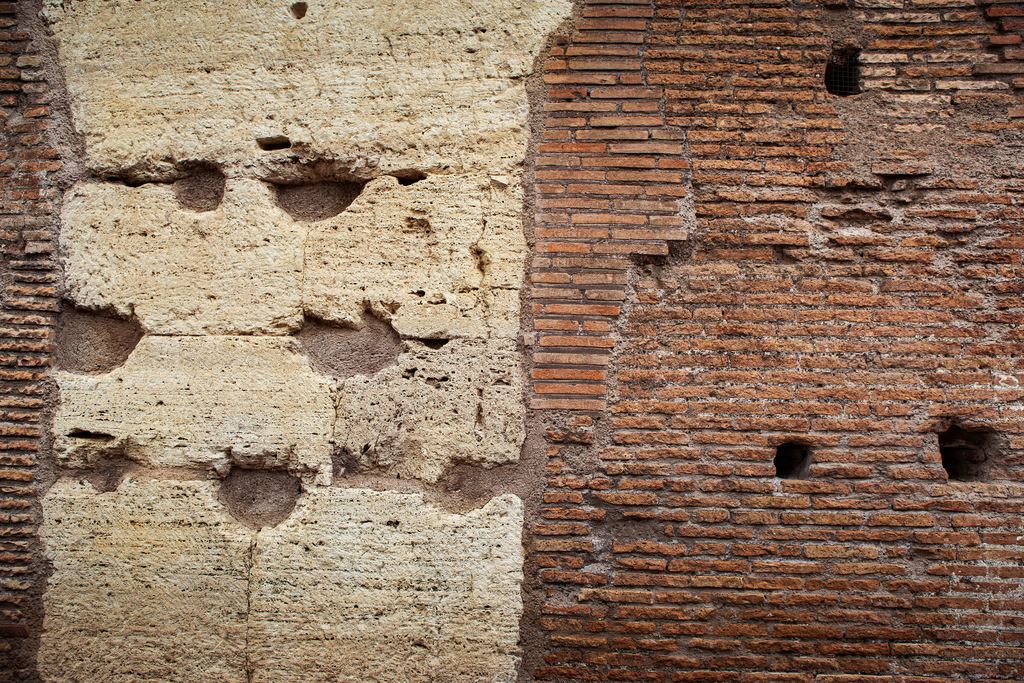
Roman concrete was laid, not poured
This is the single most useful correction to make about the building. Opus caementicium is not fluid concrete. The Romans mixed a mortar of lime and volcanic ash, then placed the aggregate into it by hand, piece by piece, in horizontal layers, the lumps roughly fist-sized.
That changes what the dome is. It is not a cast shell; it is a very carefully assembled stack in which somebody chose, layer by layer, what stone to put in. And that choice is what keeps it standing.
The ash is pozzolana, which sets even under water. Its name comes from Pozzuoli near Naples, by later tradition: Vitruvius describes the material without ever calling it that, writing only of a kind of powder found in the region around Baiae.
What actually holds it up
Ask why the dome does not fall down and most sources will tell you the coffers lighten it. It is a satisfying answer and it is not the right one.
The structural engineer Robert Mark measured it in 1987: the coffering removes less than five per cent of the dome's total mass. That is not nothing, but it is not what makes a 43-metre unreinforced span possible either.
Two other things do, and both are invisible.
The concrete gets thinner as it rises, from something like 5.9 metres where it springs off the wall to about 1.5 at the rim of the oculus. The heavy work is done low down, where the structure needs to resist spreading outwards; by the top there is very little left to hold up.
And the aggregate gets lighter as it rises. Lancaster identifies at least six distinct strata. At floor level the concrete is loaded with travertine, the heaviest stone available. Higher up it turns to tuff. Inside the dome itself the aggregate is broken brick to about 11.75 m above the springing, at roughly 1,600 kg per cubic metre; then a band of about 225 cm where brick and tuff alternate; then, for the last nine metres or so, light tuff and volcanic scoria, down to about 1,350.
Somebody planned that, in advance, and then supervised it for years. It is a more impressive achievement than a decorative pattern of squares, and it is the part nobody photographs.
The coffers, and the number 28
There are 140 coffers, in five rings of 28. The lowest four rings step back four times; the top ring steps three.
Twenty-eight is a perfect number: it equals the sum of its divisors, 1 plus 2 plus 4 plus 7 plus 14. Whether that is deliberate is not something anyone can prove, and the honest position is that it might be a coincidence in a culture that cared about such things. We mention it because it is true and interesting, not because it proves anything.
What the coffers were originally decorated with is genuinely unknown. You will read that each held a gilded bronze rosette. The Cambridge volume calls the original decoration a matter of conjecture, which means the rosettes are a reasonable guess that has hardened into a fact through repetition. The same applies to the eagle-and-wreath reconstruction often drawn in the pediment: inspired, and unprovable.
In the walls
The arches you cannot see
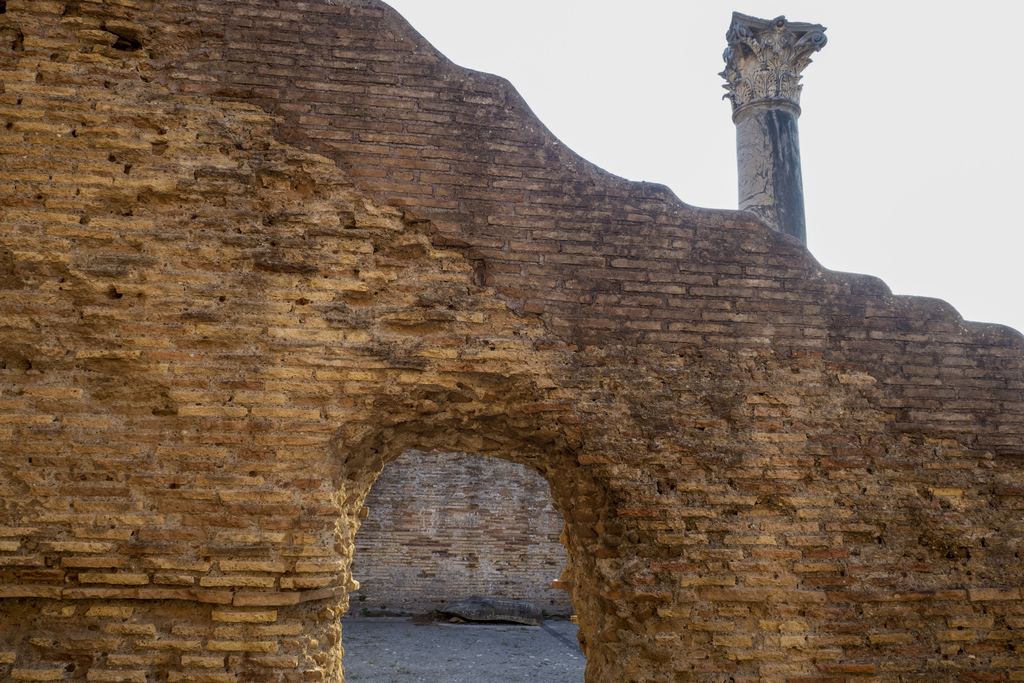
The drum is not a solid cylinder. It is about six metres thick and hollow in places, carrying internal chambers and vaults, with relieving arches built into the mass in bipedales, the two-foot bricks the Romans used for exactly this.
Those arches gather the load and pass it down through eight massive piers rather than spreading it evenly round the ring. You can read them on the bare brick outside, which is one reason the exterior is worth walking round: the back of the Pantheon shows you the engineering that the marble inside conceals.
The seven recesses in the wall are not decoration either. Removing that much material from between the piers is what makes the drum light enough to be worth building.
Sixteen columns, and two colours of stone
The portico is carried on sixteen monolithic granite columns, each a single piece about 11.7 m long and weighing something in the order of 50 tonnes. Eight stand across the front; the other eight are arranged behind them in two rows of four, forming a central passage and two side aisles that end in niches.
They are two different stones and once you know it you cannot stop seeing it. The eight in front are grey, quarried at Mons Claudianus in the Egyptian eastern desert. The eight behind are pink, from Aswan, six hundred kilometres further up the Nile. Capitals and bases are Greek marble from Pentelikon. The only Italian stone in the whole assembly is the Carrara of the interior aedicule capitals.
Each of those shafts was cut in Egypt, dragged to the Nile, floated down it, shipped across the Mediterranean, brought up the Tiber and raised upright in Rome. Sixteen times. The frequently repeated figure of 60 tonnes traces back to a commercial website; the laser survey work gives about 50.
The bronze doors are ancient, possibly the oldest thing in the building, and measure 4.45 by 7.53 metres. Both leaves were made to swing again in a 1998 restoration.
Is it really still the biggest
Yes, with the qualification stated properly: the largest dome in unreinforced concrete. Modern domes are bigger and are made of steel, or of reinforced concrete, which is a different material with different rules.
The comparison people reach for is Brunelleschi's dome in Florence, which spans about 44 metres. But Florence is built of brick over an octagon, with chains and a double shell, and it was finished thirteen centuries later. It is a magnificent solution to a problem the Pantheon solved in a completely different way, and calling either one the winner misses what is interesting about both.
One thing to be careful of: you may have read that the MIT study on self-healing Roman concrete explains the Pantheon's survival. It does not. Those samples came from Privernum, and the word Pantheon does not appear in the paper. There has never been a modern chemical or mineralogical study of the mortar of this building. We keep a list of that sort of thing.
The dome, briefly
How big is the Pantheon's dome?
43.3 metres in interior diameter, and the same from the floor to the oculus, so the interior contains a perfect sphere. A recent laser survey gives 43.56, which is a real measurement difference rather than a rounding error.
Is it still the largest concrete dome?
Yes, the largest unreinforced concrete dome in the world, nineteen centuries on. Larger modern domes use steel or reinforcement, which is a different structural problem.
How wide is the oculus?
Thirty Roman feet, about 9 metres, per the Cambridge reference following Pelletti's survey. The 8.2 m figure on the basilica's own website is an error, and Hannah and Magli give 8.3, which remains unresolved.
Do the coffers make the dome lighter?
Barely. Robert Mark measured the saving at under five per cent of the dome's mass in 1987. What makes the span possible is the thinning of the concrete from 5.9 m to 1.5 m and the use of progressively lighter aggregate as it rises.
Is Roman concrete self-healing, and is that why it survived?
The self-healing research is real, but the samples came from Privernum, not the Pantheon, and the paper never mentions this building. No modern study of the Pantheon's own mortar exists. Its survival owes more to a lead roof installed in the eighth century.
What are the columns made of?
Granite, in two colours: the eight front shafts are grey from Mons Claudianus in Egypt, the eight behind are pink from Aswan. Each is a single stone about 11.7 m long weighing roughly 50 tonnes.
The other thing the oculus does
It throws a nine-metre disc of sunlight that lands somewhere different every day. We calculated where, month by month.
Data verified on. Dimensions, coffers, materials and aggregate grading from Marder and Wilson Jones, The Pantheon (Cambridge, 2015), De Fine Licht 1968 and Lancaster. Coffer weight from R. Mark, 1987.