
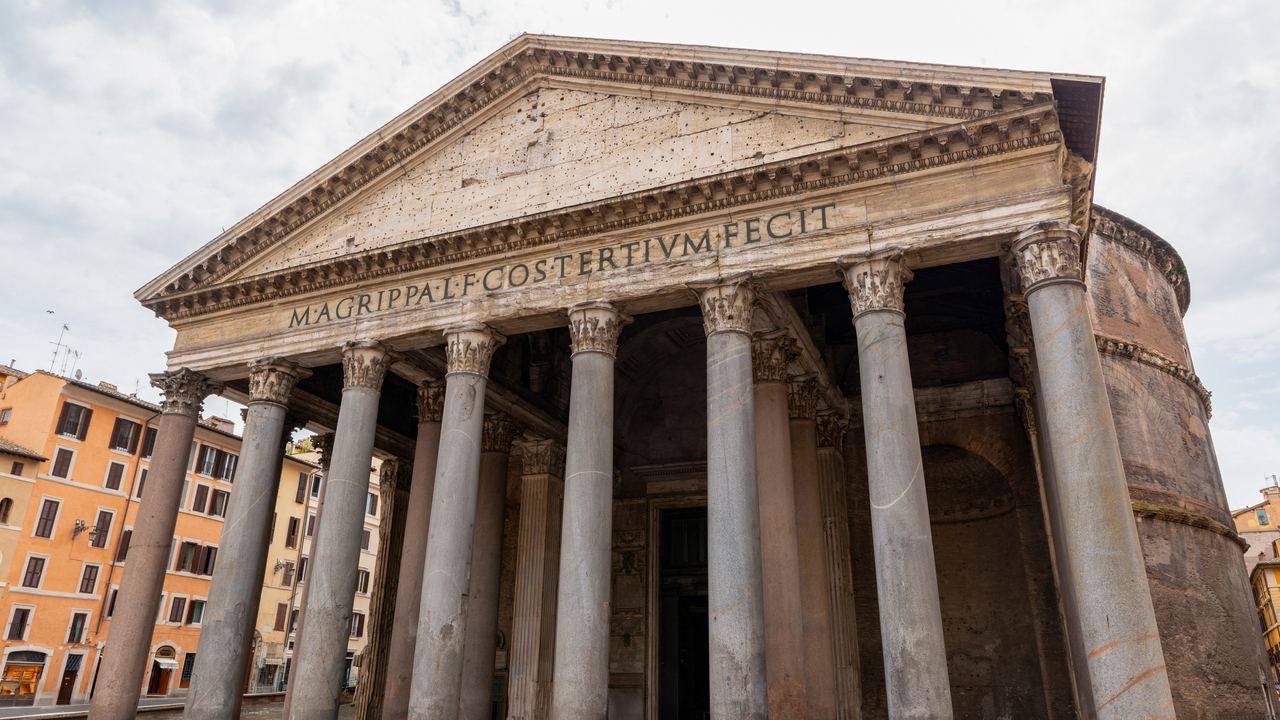
Almost everyone walks in under an inscription naming a man who had nothing to do with the building above it. That is the first thing to sort out, and it opens onto the second, which is why this particular Roman building is standing when almost none of the others are.
The short answer to the second question is not the concrete. It is a lead roof, laid by a pope in the eighth century, and a change of ownership.
Nineteen centuries, in twelve dates
Where the year is disputed we have said so rather than picking one. There is more disagreement in this list than most accounts admit.
The origins
27 BC
Agrippa builds the first Pantheon
Marcus Agrippa, Augustus's son-in-law and admiral, puts up a building on this site during his third consulship. Excavations in 1996 and 1997 established that it faced north, like the present one, overturning the older idea that it was rectangular and faced south.
AD 80
Fire
Agrippa's building burns in the fire of Titus's reign. It is repaired under Domitian.
about AD 110
Fire again
A second fire, this time under Trajan. After this the site is not repaired but rebuilt from the ground, which is what makes the present building possible.
about AD 114
The rebuild begins
Brick stamps place the start of work in the late Trajanic period, several years before Hadrian became emperor. Whoever designed it, the project was under way before he inherited it.
AD 125 to 128
Finished, and credited to someone else
Completed under Hadrian, who puts Agrippa's name back across the front rather than his own. This was not modesty: restoring the original dedicator's inscription was his systematic practice on every building he repaired, and an ancient biography says so directly.
AD 202
A second inscription, in smaller letters
Septimius Severus and Caracalla restore the building and record it on the frieze below Agrippa's line: the Pantheon, worn by age, restored with every care. It is barely legible now, and most visitors never notice it.
The growth
609 or 610
It becomes a church
The emperor Phocas gives the building to Pope Boniface IV, who consecrates it to St Mary and the Martyrs on 13 May. The day is secure; the year is not. The Liber Pontificalis gives no date at all, and 609, 610 and 613 have all been argued.
663
The gilded roof tiles leave
The emperor Constans II strips the gilded bronze tiles from the roof. They never reach Constantinople: the ships are taken by Saracen raiders and the bronze ends up in Alexandria, by way of Syracuse.
731 to 741
The lead roof, and the reason it is still here
Pope Gregory III re-covers the exposed roof in lead. Mark Wilson Jones calls it by far the most important single protective measure in the building's history. Everything else on this page is decoration compared with keeping the water out for a thousand years.
1520
Raphael is buried here
He dies on 6 April and is interred the next day, in a tomb he had bought and an ancient aedicule he had paid to restore. He was not given it, and he was not the first person buried in the building. He was the first modern artist.
1626
Urban VIII takes the bronze
152.7 tonnes are stripped from the portico roof structure. About 91 per cent of it goes to make cannon for Castel Sant'Angelo. The story that it became Bernini's canopy in St Peter's does not survive an examination of the accounts.
April 1883
The bell towers come down
Two pairs of towers, designed and built by Carlo Maderno, are demolished on the decision of Guido Baccelli, the education minister who had personally struck the first blow in 1881. It was not a restoration: it was a de-Christianising, clearing the way for the tomb of a king.
Whose building is it
The inscription reads M AGRIPPA L F COS TERTIVM FECIT: Marcus Agrippa, son of Lucius, made this in his third consulship. Every word of that is true about a building that burned down twice and no longer exists.
The usual explanation is that Hadrian was modest. He was not. Restoring the original dedication was his standard policy across the empire, recorded as such in the Historia Augusta, and he did it everywhere he rebuilt. Reading it as personal humility turns an administrative habit into a character trait.
There is even a wrinkle in the inscription itself. COS TERTIUM is normally read as during his third consulship, which dates it to 27 BC. But Roman coinage sometimes used the same formula long afterwards as a standing title, meaning consul three times, in which case it is not a date at all. The Cambridge volume flags both readings.

Look lower
The inscription almost nobody reads
Under Agrippa's line, on the frieze, there is a second and much smaller inscription. It records a restoration by Septimius Severus and Caracalla in AD 202, and it ends with the phrase Pantheum vetustate corruptum cum omni cultu restituerunt: they restored the Pantheon, decayed with age, with every care.
It is worn nearly flat and you need to know it is there to find it. What it tells you is that the building was already considered old, and already needed looking after, seventy-five years after it was finished.
Why this one survived
Rome is full of Roman buildings that are not there any more. They came down because they were quarries: a standing structure full of cut marble, bronze fittings and dressed stone, unowned and unguarded, is a building material depot.
Two things saved the Pantheon, and neither is engineering.
It got an owner. Becoming a church in 609 or 610 meant somebody was responsible for it, held services in it, and objected when people arrived with carts. Consecration is the most effective preservation measure in the history of Roman architecture.
It got a roof. Constans II had stripped the gilded bronze tiles in 663, leaving the structure exposed. Between 731 and 741 Gregory III covered it in lead, and that is the intervention that Wilson Jones singles out above all others. Roman concrete is durable; Roman concrete under standing water is not.
It is worth sitting with how close the margin was. Seventy years of an unroofed dome, in a city with 800 millimetres of rain a year, and then somebody fixed it.
The bronze, and the joke that outlived the facts
In 1626 Urban VIII, a Barberini, had the bronze stripped from the portico's roof structure. The Roman quip that followed, what the barbarians did not do, the Barberini did, is genuinely good and has kept the story alive for four hundred years.
The version usually attached to it is wrong. The bronze is supposed to have become Bernini's baldachin over the high altar of St Peter's. Two independent examinations of the accounts, a century and a half apart, show that about 91 per cent of the 152.7 tonnes went to the foundry at Castel Sant'Angelo to be cast into cannon, that the portion sent towards St Peter's came back unused, and that the copper in the baldachin was bought from Venice.
You will also see the figure given as 225 tons. That is a unit error: Roman pounds read as English pounds.
1883
The towers that were never Bernini's
For two and a half centuries the Pantheon had bell towers, and they were widely disliked. Rome called them the donkey's ears, and popular tradition blames Bernini for them.
He cannot have built them. They were the work of Carlo Maderno, with Borromini and Domenico Castelli, and Bernini only succeeded Maderno at the Fabbrica di San Pietro in 1629, three years after the work. There were also two pairs of them, not one.
They came down in April 1883, and the motive was political. The kingdom of Italy had taken Rome in 1870, the Pantheon now held the tomb of Vittorio Emanuele II, and stripping the Christian additions turned a basilica back into a Roman monument that a secular state could claim.
What we do not know
Three gaps worth naming, because they are usually filled with confident sentences.
Who designed it. No source names an architect. Apollodorus of Damascus is often suggested and there is no evidence for it.
What it was for. The name means something like of all the gods, and Cassius Dio, writing a century after it was built, already did not know why: he offers the statues of many gods, then adds his own view that the dome resembles the heavens. Some scholars argue the name was a nickname rather than an official dedication. Calling it a temple to all the gods as a plain fact goes further than the evidence.
What the 1930s restorations found. Alberto Terenzio's documentation of the 1930 to 1931 work was promised in 1932 and never published. A great deal of what is known about the internal structure rests on De Fine Licht's 1968 study, which in turn rests on Terenzio. It is the largest hole in the literature on this building.
History, briefly
Who built the Pantheon?
The building standing today was completed under Hadrian, between about AD 125 and 128, on a rebuild begun around 114. Agrippa's original of 27 BC burned down. No source names the architect.
Why does the inscription say Agrippa?
Because Hadrian restored the original dedicator's name, which was his standard practice on every building he rebuilt across the empire. It was policy, not modesty.
How old is the Pantheon?
The present building is about 1,900 years old. It has been in continuous use that whole time, first as a Roman monument and, since 609 or 610, as a church.
Why is the Pantheon so well preserved?
Two reasons, neither of them structural. It became a church in the seventh century, which gave it an owner who objected to people taking the marble. And Pope Gregory III re-roofed it in lead between 731 and 741, after the gilded bronze tiles had been stripped in 663.
Did the Pantheon's bronze become Bernini's baldachin?
No. Archival work shows about 91 per cent of the 152.7 tonnes went to make cannon at Castel Sant'Angelo, the portion sent towards St Peter's came back unused, and the baldachin's copper was bought from Venice.
When did the Pantheon become a church?
On 13 May, in either 609, 610 or 613. The day is well attested in medieval liturgical calendars; the year is not documented anywhere, and 609 is the Church's preferred choice rather than an established fact.
The tomb that made it a pantheon again
Raphael's burial in 1520 turned a Roman temple into the resting place of artists, and later of kings. Fourteen documented burials, told apart from the memorials.
Data verified on. Dates, inscriptions and the bronze accounts from Marder and Wilson Jones, The Pantheon (Cambridge, 2015), including Thuno on the consecration date and the 1996-97 Agrippa excavations.