
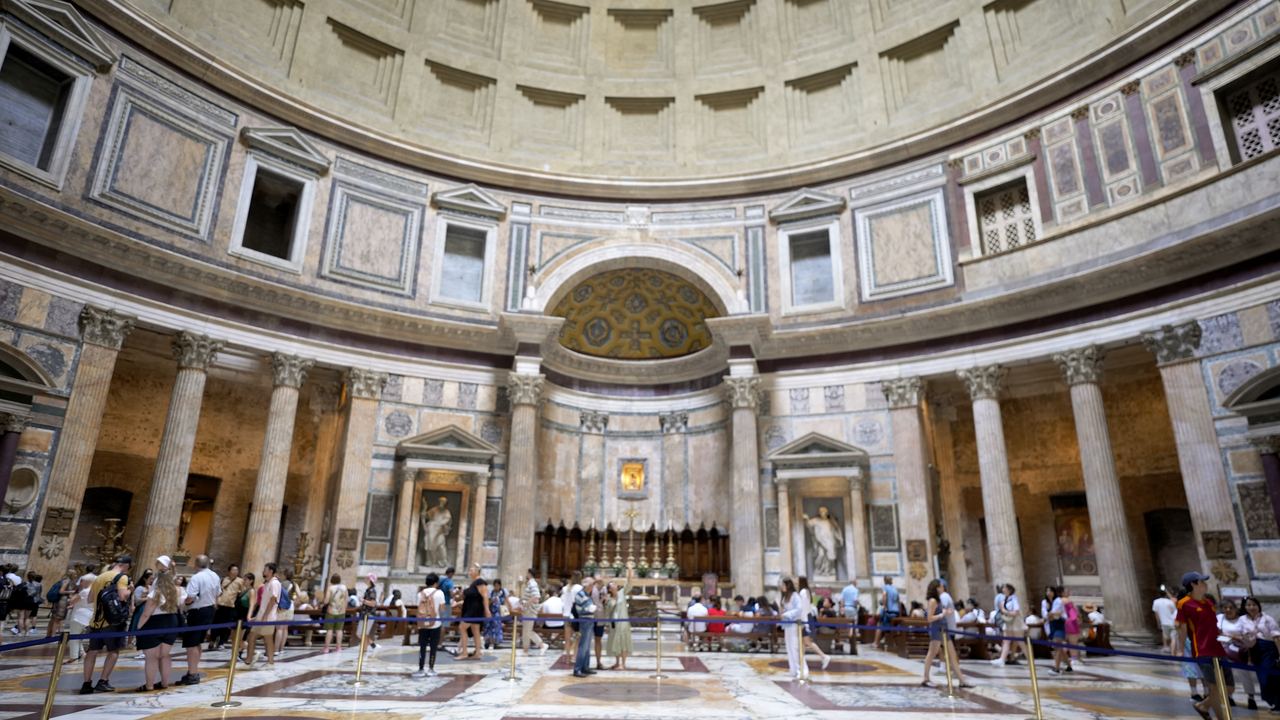
Of the twelve Pantheon websites we surveyed in August 2026, not one had a page about accessibility. Not a paragraph, not a line in an FAQ. The information exists, it is published by the ministry in Italian and English, and apparently nobody has bothered to carry it across.
So this page carries it across, and marks clearly which parts are official and which are only reported by visitors, because on this subject the difference matters more than usual.
Getting in with a wheelchair or limited mobility
The official instruction is specific: access for visitors with disabilities or reduced mobility is by the external ramp on the Via della Minerva side, which is the left flank of the building as you face the portico. Staff are stationed on that side, next to the ramp.
Admission is free for a visitor with a disability and one companion, under the rule that applies across Italian state museums. The companion needs to show either a family relationship or membership of a care service.
Inside, the building helps: it is one round room with a level floor, no stairs, no upper gallery, nothing to climb. The difficulty is entirely at the threshold, not beyond it.
One caution about what is not published. Several accessibility writers report that the main entrance under the portico has original Roman steps that a wheelchair cannot manage, which would explain why the ramp exists. No official source describes that level difference. The ramp is documented; the reason for it is not. We are telling you that because if you are planning a visit around a wheelchair, an inference is worth less than a phone call.

Not in the brochures
There is no cloakroom, and no toilet
The ministry states plainly that no cloakroom service is provided. Nothing can be left, so bring what you can carry comfortably through a half-hour visit.
On toilets, the official sources say nothing at all, in either direction, which after some searching we have concluded means there are none to speak of. The nearest public facility is P.Stop on Via Zanardelli, behind Piazza Navona, about a five to seven minute walk, 1.50 euro, open 8:30 to 20:30, with an accessible cubicle and a baby-changing table.
Bars around the square will generally let a paying customer use theirs. An espresso at the counter costs about the same as the public toilet and comes with a coffee.
The dress code is real, and it is enforced
This is not blog folklore. It is published policy, and the wording is unambiguous:
- clothing appropriate to a place of worship is required
- shoulders must be covered
- no very short shorts or skirts, nothing excessively low-cut
- no see-through garments
And then the sentence that most summaries leave out: security and reception staff are authorised to deny entry to anyone who does not comply. Enforcement in practice is reported as looser than at St Peter's and stricter than at nothing at all, which is an unsatisfying answer, but the published rule is the published rule and the discretion sits with the person at the door, not with you.
A light scarf solves it in one second and weighs nothing. In July, when the alternative is a long-sleeved shirt in 31 degrees, that is not a small thing.
The reason for the rule is that this is not a ruin. It is the parish church of Santa Maria ad Martyres, in use since the seventh century, with a Chapter of canons that is unique in Rome outside the four papal basilicas.
What you may and may not do inside
| Status | The actual wording, or its absence | |
|---|---|---|
| Photos with a phone | Allowed | Explicitly permitted: phones may be used for photos and video, but not for calls |
| Phone calls | Not allowed | Devices are to be switched off or silenced |
| Talking | Discouraged | Visitors are asked to keep a respectful and quiet manner. Staff do ask for silence |
| Professional camera equipment | Permission needed | Not permitted unless authorised by the management |
| Eating, drinking, smoking | Not allowed | Includes electronic cigarettes |
| Animals | Not allowed | Except guide dogs and certified medical support animals |
| Flash, tripods, large backpacks, drones | Unpublished | No rule either way. A tripod probably falls under professional equipment, but that is our reading, not a text |
We have left the last row deliberately empty rather than filling it with a confident guess, which is what most pages do. If a rule is not published, saying so is more useful than inventing it.
If you are arriving as a group
The group rules are stricter than most visitors expect, and they invalidate a number of products sold online.
- Above six people, entry is only permitted with radio guides or a whisper system.
- The group ticket covers 10 to 26 people and requires a licensed tourist guide carrying her badge, who must stay with the group throughout.
- A tour manager without that licence buys a normal ticket and may not give explanations inside the monument. Under Italian law these are two different professions.
- Group slots run hourly from 09:00, and the last one starts at 17:00. There is no group admission after 18:00.
The practical consequence: a small-group tour of eight people with no whisper system is not compliant, and neither is one led by someone who is not a licensed guide. Both exist on sale. Both are checkable before you book, by asking two questions.
Two services worth knowing about
The monument runs an inclusive visit for blind and partially sighted visitors, Ad occhi chiusi, il Pantheon attraverso i sensi, lasting about 45 minutes and booked by email. It is a periodic event, not a permanent installation: there is no standing tactile route and no braille signage that we could find documented. Nothing at all is published for deaf visitors, no Italian Sign Language provision and no captioning.
That is a real gap in a state monument taking four million people a year, and pretending otherwise would not help anyone planning a visit around it.
Access and rules, briefly
Is the Pantheon wheelchair accessible?
Yes, by the external ramp on the Via della Minerva side rather than through the portico. Inside it is a single level room with no stairs. A visitor with a disability and one companion enter free.
What is the dress code at the Pantheon?
Shoulders covered, no very short shorts or skirts, nothing low-cut or see-through. It is published policy, not a suggestion, and staff are authorised to refuse entry. A scarf is enough.
Can I take photos inside the Pantheon?
Yes, with a phone or an ordinary camera. Phone calls are not allowed and devices should be silenced. Professional equipment needs prior authorisation from the management.
Is there a toilet or a cloakroom?
No cloakroom, stated officially. On toilets the official sources are silent; the nearest public facility is on Via Zanardelli behind Piazza Navona, about a five-minute walk, 1.50 euro.
Can I bring a large backpack?
There is no published rule and no cloakroom to leave it in, so plan on carrying whatever you bring. Security screening is at the entrance.
How long should I allow for the visit?
No official duration exists. The audio guide runs about 50 minutes across 15 stops, and guided visits are timetabled at 45 to 50. The room itself can be seen in twenty minutes and repays an hour.

Two minutes away
If you are turned away, or it is closed
Piazza della Minerva is round the back, and Bernini's elephant is standing in it carrying the shortest obelisk in Rome. The church behind it, Santa Maria sopra Minerva, is free, has no dress inspection at the door and contains a Michelangelo.
San Luigi dei Francesi, five minutes the other way, is also free and holds three Caravaggios. Neither is a consolation prize.
The rules exist because it is a church
Santa Maria ad Martyres has been a working parish since the seventh century, and it is the only collegiate basilica in Rome outside the four papal ones.
Visiting with children
Nothing on this page changes for families, but four things are worth knowing before you arrive with one.
Under-18s enter free, of any nationality, which makes this one of the cheapest hours in central Rome for a family. They still need to be on the booking if you booked, and the personal-ticket rule applies to them too.
There is no pushchair rule published, in either direction, and the building is a single level room with no stairs, so the practical obstacle is the threshold rather than the interior. If you cannot manage the portico steps with a pram, the ramp on the Via della Minerva side is the way in.
The silence rule is real, and it is the part that catches families out. Staff do ask visitors to keep quiet, this is a working church, and the acoustics of a 43-metre dome amplify everything. Children who would be unremarkable in a museum are audible here from any point in the room.
The visit is short, which helps. Twenty minutes covers it, there is nothing to queue for inside, and the thing children reliably react to is the hole in the ceiling. Point at it before anything else, wait for them to work out that it is open to the sky, and the rest of the visit gets easier.
Data verified on. Access, dress code, conduct and group rules from the Direzione Musei nazionali di Roma, Italian and English pages. Free-admission categories from the Ministry of Culture.