
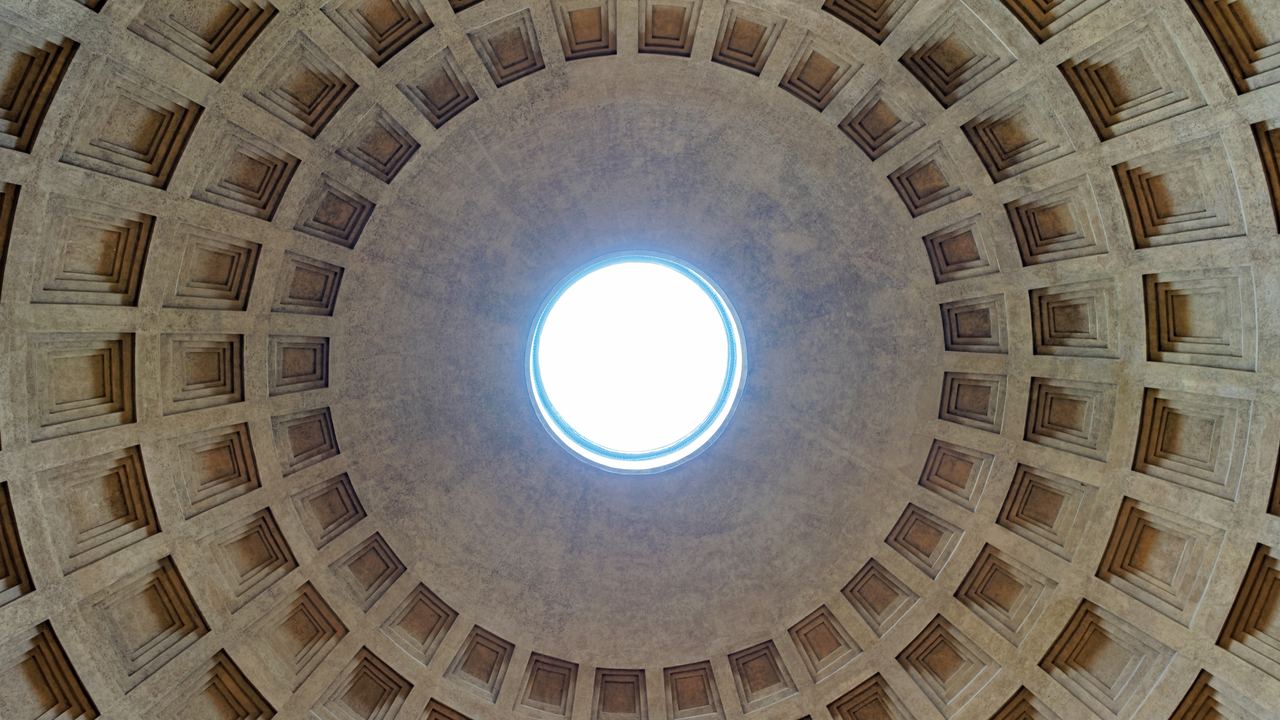
Every famous building accumulates these. The Pantheon's are unusual in that several of them come from institutions rather than from tour guides: the basilica's own website publishes an oculus measurement that is off by almost a metre, and one of the most repeated stories about Roman concrete has been attached to this building by people who never read the paper.
We are not trying to spoil anything. Most of the true stories here are better than the false ones.
About the building
| The claim | What is actually the case |
|---|---|
| The MIT study on self-healing Roman concrete explains the Pantheon | The samples came from <b>Privernum</b>, and the word Pantheon never appears in the 2023 paper. No modern chemical study of this building's mortar exists at all |
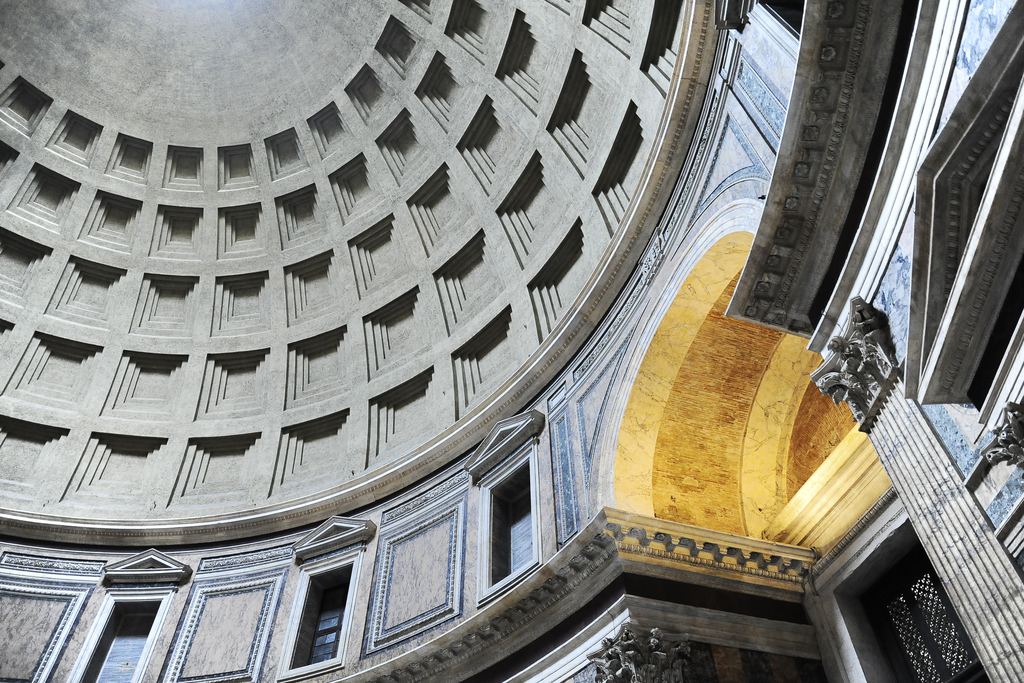
| The coffers make the dome light enough to stand | They remove <b>under five per cent</b> of its mass (R. Mark, 1987). The span works because the concrete thins from 5.9 m to 1.5 m and the aggregate gets lighter with height |
| The oculus is 8.2 metres across | Thirty Roman feet, <b>about 9 m</b>. The 8.2 figure is on the basilica's own site and is probably 27 feet misread for 30 |
| The coffers held gilded bronze rosettes | Possible, unproven. The Cambridge volume calls the original decoration a matter of conjecture. The same goes for the eagle often drawn in the pediment |
| The floor is the original Roman one | The design and the marbles are ancient, but roughly <b>two thirds is modern or reset</b>, largely in an 1873 campaign, with Siena yellow patched in for the more fragile giallo antico |
| The columns weigh 60 tonnes each | About <b>50</b>, from laser survey work. The 60 traces back to a commercial website |
| Roman concrete was poured | It was <b>laid by hand</b>: mortar of lime and volcanic ash, with fist-sized aggregate placed into it in horizontal courses |
| Vitruvius calls the volcanic ash pulvis puteolanus | He does not. In <i>De architectura</i> II.6 he writes of a kind of powder found in the region around Baiae. The name comes from later writers |
The one worth dwelling on
Yes, the rain comes in
You will be told, sometimes by a guide standing in the square, that rain never reaches the floor: that warm air rising through the oculus atomises the drops before they land.
The basilica's own website calls this the most famous, and false, legend about the building, and explains that the water falls onto the marble and drains away. There is a physical effect involved, and in very light rain a thermal draught can indeed break drops into mist. It does not keep the water out.
The strongest evidence is historical rather than meteorological. Four centuries of popes tried to close the oculus to stop water getting in: Giacomo della Porta in 1591, Alexander VII in 1660, James Gibbs in the eighteenth century. In 1880 a proposal for a tomb in the centre of the floor was refused partly because the ancient drains would not have coped. Nobody spends three hundred years solving a problem that does not exist.
About the history
| The claim | What is actually the case |
|---|---|
| The Pantheon's bronze became Bernini's baldachin in St Peter's | <b>None of it did.</b> Two independent examinations of the accounts, 150 years apart, show about 91 per cent of the 152.7 tonnes went to cannon at Castel Sant'Angelo, the rest came back unused, and the baldachin's copper was bought from Venice |
| Urban VIII removed 225 tons of bronze | <b>152.7 tonnes.</b> The 225 is a unit error: Roman pounds read as English pounds |
| Bernini built the bell towers | <b>Carlo Maderno</b> did, with Borromini and Domenico Castelli. Bernini succeeded Maderno in 1629, three years later. There were also two pairs, not one, and they came down in April 1883 |
| Twenty-eight cartloads of martyrs' bones were brought from the catacombs | An invention of the Counter-Reformation, attributed to Cardinal Baronio in <b>1586</b>, nearly a thousand years after the events. Absent from the Liber Pontificalis. Still repeated on the basilica's site |
| Hadrian left Agrippa's name out of modesty | It was <b>systematic policy</b> on every building he restored, stated as such in the Historia Augusta |
| Agrippa's Pantheon was rectangular and faced south | Excavations in 1996 and 1997 showed it faced <b>north</b>, like the present building |
| Raphael was the first person buried in the Pantheon | It had been a church with relics for nine centuries. He was the first <b>modern artist</b>, which is the interesting claim |
| Michelangelo is buried in the Pantheon | Santa Croce, Florence. He had a memorial bust here until 1820, when all of them were moved to the Capitoline |
About visiting it
Two of these are commercial rather than historical, which makes them the ones most likely to cost you money.
Skip-the-line access does not exist here. The ministry states it twice on its own page. The ticket is personal and identity documents are checked at a single doorway, so there is nowhere for a priority lane to go. Ten of the twelve Pantheon ticket sites we surveyed in August 2026 sell one anyway.
The floor does not have exactly twenty-two drainage holes. Or it may: the point is that nobody has published a figure that can be checked. The number appears on tourist sites and on the Italian Wikipedia entry, flagged there as unsourced, and is absent from the Cambridge volume and the archaeological literature, which describe the drainage without ever counting it. We have no idea how many there are, and neither does anybody writing confidently that there are twenty-two.
And a smaller one: the building is often described as a minor basilica. What the Vicariate actually calls it is a collegiate basilica, which is a rarer and more interesting status: it is the only church in Rome outside the four papal basilicas governed by its own Chapter of canons. The minor basilica label appears to come from database entries rather than from any decree.

A curiosity
The article that does not exist
Our favourite. A 2009 paper by Lise Hetland, Zur Datierung des Pantheon, is cited in a number of places as evidence for the building's dating.
It does not exist. Searching the scholarly indexes returns nothing. What Hetland actually wrote is Dating the Pantheon, in the Journal of Roman Archaeology volume 20, in 2007, and it is a genuinely important piece of work: it is the argument that the rebuild began under Trajan rather than Hadrian.
Somewhere a citation was mangled, and the mangled version propagated because nobody chasing it ever went to look. It is a good reminder that a footnote is only as good as the last person who checked it, and that includes ours.
One we cannot settle
Not everything on a list like this resolves into true or false, and it would be dishonest to pretend otherwise.
Was it a temple to all the gods? The name says so, more or less, and it is what every guidebook prints. But Cassius Dio, writing about a century after the building went up, already did not know why it was called that: he offers the statues of many gods, and then adds his own opinion that the dome resembles the heavens. Some scholars argue Pantheon was a nickname rather than an official dedication, and note that ancient writers never use the ordinary word for a temple about the Hadrianic building.
So the honest formulation is that the name means of all the gods, and that the Romans themselves were already arguing about why. That is less satisfying than a fact and more interesting than a myth.
The ones we get asked most
Does rain fall inside the Pantheon?
Yes. The basilica's own website calls the opposite claim a false legend and explains that water falls onto the floor and drains away. A thermal draught can mist very light rain, but it does not keep it out.
Is the Pantheon made of self-healing concrete?
The self-healing research is real and Roman, but the samples came from Privernum and the paper never mentions the Pantheon. No modern analysis of this building's mortar has ever been published.
Did Bernini take the Pantheon's bronze for his baldachin?
No. About 91 per cent of the 152.7 tonnes went to make cannon at Castel Sant'Angelo, the portion sent to St Peter's came back unused, and the baldachin's copper was purchased from Venice.
Do the coffers hold the dome up?
They remove under five per cent of its weight. The real answers are the thinning of the shell from 5.9 m to 1.5 m and the progressively lighter aggregate, from travertine at the bottom to volcanic scoria at the top.
How many drainage holes are in the floor?
Nobody has published a verifiable figure. The commonly cited twenty-two is unsourced and absent from the archaeological literature, which describes the drainage without counting it.
Several of these are vocabulary problems
Skip-the-line, minor basilica, spolia, cella. Four words that get used about this building and mean something else.
Data verified on. Corrections drawn from Marder and Wilson Jones, The Pantheon (Cambridge, 2015), R. Mark 1987, Seymour et al. 2023, Vitruvius II.6 and the ministry's own pages.