
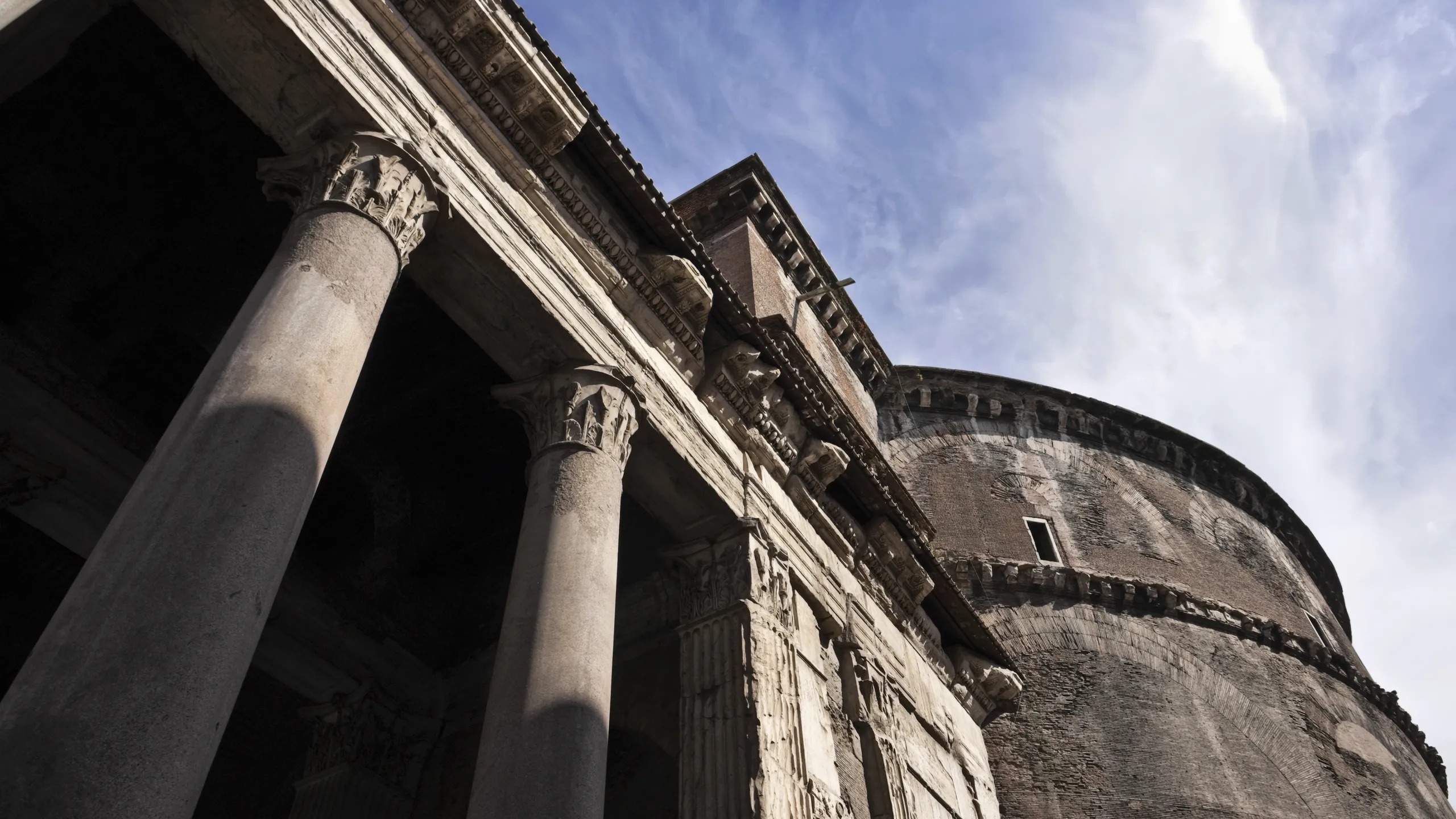
Two kinds of vocabulary get in the way at this building. There is the architectural kind, where a sign says pronao and assumes you know. And there is the commercial kind, where three different products are sold under words that sound interchangeable and are not.
Both are here. Every entry says where you can see the thing, because a glossary that does not connect a word to an object is a list of definitions rather than a way of understanding a room.
The building
| English | Italian | What it means | Where it is here |
|---|---|---|---|
| Portico | portico | The columned porch in front of the building | The eight-column front you walk through |
| Pronaos | pronao | The vestibule between the columns and the door | Same structure, seen from inside it |
| Pediment | frontone | The triangular crowning of the portico | Above the inscription. It once held a bronze relief, now lost |
| Tympanum | timpano | The flat field inside the pediment | Empty now. The fixing holes are still visible |
| Entablature | trabeazione | Everything horizontal above the columns | It carries both inscriptions |
| Architrave / frieze / cornice | architrave / fregio / cornice | The three bands of the entablature, bottom to top | Agrippa's line and, below it, the smaller one of AD 202 |
| Shaft | fusto | The body of a column, between base and capital | Sixteen of them, each a single stone about 11.7 m long |
| Monolithic column | colonna monolitica | A shaft cut from one block, not drums | All sixteen. Roughly 50 tonnes each |
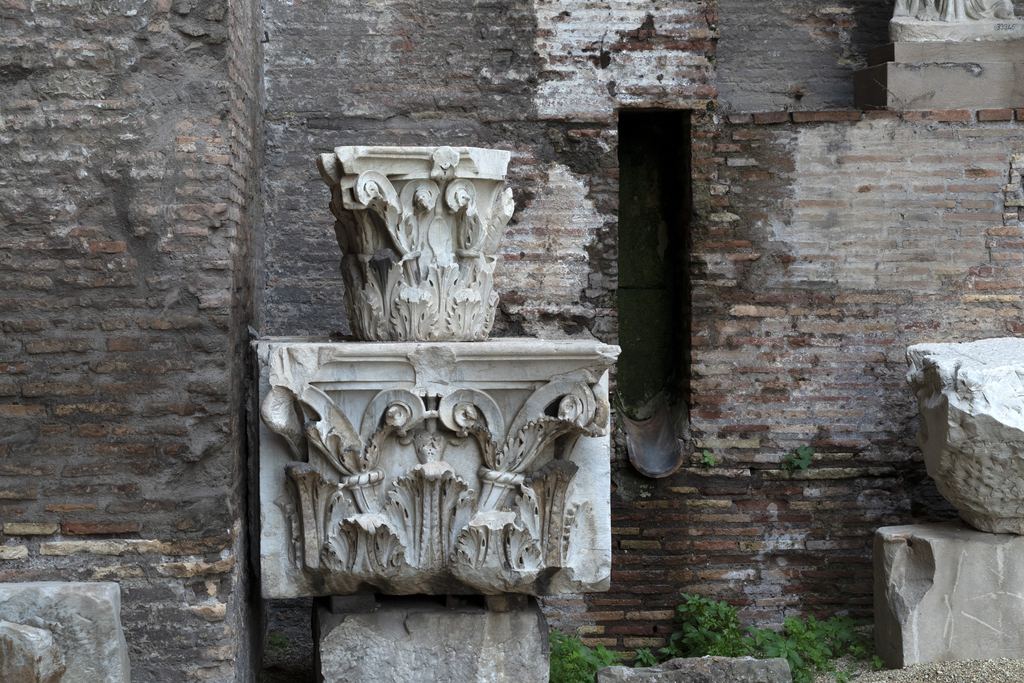
| Capital | capitello | The carved top of a column | Corinthian, in Pentelic marble from Greece |
| Corinthian order | ordine corinzio | The order with acanthus-leaf capitals | The only order used in the whole building |
| Rotunda | rotonda | A circular building under a dome | The round room. It gave the square its name |
| Drum | tamburo | The cylindrical wall carrying a dome | About 6 m thick, and hollow in places |
| Relieving arch | arco di scarico | An arch buried in a wall to redirect load | Visible in the bare brick outside, in two-foot bricks |
| Exedra | esedra | A large recess in a wall, curved or square | Seven of them, alternating in shape, screened by columns |
| Aedicule | edicola | A small shrine framed by columns and a pediment | Eight, between the exedrae. Raphael's tomb is in one |
| Attic | attico | The storey between the main order and the dome | Rebuilt in the eighteenth century. One stretch was restored to the ancient design |
| Intrados | intradosso | The inner surface of a vault or dome | The coffered surface you look up at |
| Coffer | cassettone, lacunare | A sunken panel in a ceiling or vault | 140 of them, in five rings of 28 |
| Oculus | oculo | A circular opening at the top of a dome | About 9 m across, never glazed |
| Apse | abside | The semicircular end containing the altar | Opposite the door, with a seventh-century icon |
The materials
Words for the stone
Opus caementicium is Roman concrete: lime mortar with volcanic ash, and aggregate laid in by hand rather than poured. Pozzolana is that ash, named after Pozzuoli by later tradition. Caementa are the aggregate pieces themselves, roughly fist-sized.
Travertine and tuff are the two local stones, the first heavy and the second light, and which one is in the mix tells you how high up you are. Scoria is the volcanic material at the very top, like pumice but denser.
Of the coloured stones, granite is the portico, porphyry the deep purple, giallo antico the yellow and pavonazzetto the veined white and violet. Almost all of it came from Egypt, Greece and North Africa. The only Italian marble in the building is the Carrara of the interior capitals.
Opus latericium, brick-faced concrete, is what the outside of the rotunda is, and it was never meant to be seen bare.
The church
The Pantheon has been Santa Maria ad Martyres since the seventh century, and a working parish is why there is a dress code and why the doors close for Mass.
| English | Italian | What it means | Here |
|---|---|---|---|
| Basilica | basilica | A title of honour, not a shape of building | The full name is Basilica di Santa Maria ad Martyres |
| Collegiate church | collegiata | A church governed by a college of canons | The only one in Rome outside the four papal basilicas |
| Chapter | capitolo | That college itself | Twelve canons, plus six honorary |
| Titular church | chiesa titolare | A church assigned to a cardinal | It is <b>not</b> one, and not a parish in the ordinary sense either |
| Martyrium | martyrium | A building holding the remains of martyrs | The sense of the dedication <i>ad Martyres</i> |
| High altar | altare maggiore | The principal altar | In the apse, moved towards the centre in 1491 |
| Reliquary | reliquiario | A container for relics | A porphyry basin beneath the high altar |
| Ambo | ambone | The reading desk for the liturgy | A modern work by Federico Severino |
| Sacristy | sacrestia | The room for vestments and vessels | Leads to the chapel of St Catherine |
What you are actually buying
This section exists because these words cost money, and because two of them are sold as synonyms while meaning different things.
| Term | What it really means | At the Pantheon |
|---|---|---|
| Timed entry | An assigned hour band | <b>This is the real regime.</b> Nine slots from 9:00, up to 1,200 people in each |
| Reserved entry | A guaranteed place within a slot | What you are actually buying. It is not a faster lane |
| Skip the line | A separate priority queue | <b>Does not exist.</b> The ministry says so twice on its own page |
| Licensed guide | guida turistica abilitata: national exam, public register, badge with photo and number | May interpret the monument. Enters free |
| Tour leader / tour manager | accompagnatore turistico: handles logistics and the trip | Buys a normal ticket and <b>may not give explanations inside</b> |
| Whisper system | radioguide: transmitter and earpieces | <b>Required above six people.</b> A group of eight without them is not compliant |
| Audio guide | audioguida: a recorded commentary you follow alone | About 50 minutes, 15 stops. Sold by the basilica's Chapter, not by the state |
| Free tour | A walk paid by tipping | Legal status contested in Italy; Florence has fined operators for unlicensed guiding |
| Voucher | A proof of purchase to be exchanged | <b>Not a ticket.</b> Some resellers require collection elsewhere first |
| Combo ticket | One purchase covering several sites | Beware: the Pantheon ticket is personal and name-checked |
The distinction between a licensed guide and a tour manager is the one worth remembering, because it is a matter of Italian law rather than of marketing. Guiding is a regulated profession with an examination, a national register and a numbered badge. A tour manager is a different job. At the Pantheon the rule is written down: an unlicensed accompanying person buys a standard ticket and may not explain anything inside the monument.
So if a listing advertises a guide, the useful question is which of the two words it means. The answer changes where the commentary happens.
Words we do not use here, and why
A short list of terms that appear in Pantheon writing and should not.
- Thermal window and groin vault. Neither is a feature of this building; the portico aisles are barrel-vaulted and the dome is a hemispherical shell. Both words belong to other Roman buildings and get imported by writers reaching for something technical.
- Spolia, applied to the Pantheon's own fabric. The word means reused ancient material, and this building was the victim of that practice rather than a product of it. It is worth defining and not worth applying here.
- Cella, for the round room. It suits the Augustan building; for the Hadrianic one the word is rotunda.
- Minor basilica. The Vicariate's own term is collegiate basilica, which is both rarer and more accurate.
- Skip the line, for the reason given above and one more: with a personal, name-checked ticket, buying from an unauthorised reseller can leave you unable to enter at all. The ministry warns about exactly this.
Words people ask about
What is the oculus?
The circular opening at the top of the dome, about nine metres across, which has never been glazed or covered. It is the building's only source of daylight, and rain comes through it.
What are the coffers for?
They are the sunken panels in the dome's inner surface, 140 of them in five rings of 28. They lighten the structure slightly, by under five per cent, and they organise the surface visually. What decorated them originally is unknown.
What is the difference between reserved entry and skip-the-line?
Reserved entry means a guaranteed place in an hour band, which is what the Pantheon actually operates. Skip-the-line implies a separate faster queue, which does not exist here. The terms get used as though they were the same purchase.
What is a whisper system and do I need one?
Radio transmitters and earpieces, so a guide can speak quietly. At the Pantheon they are required for any group above six people. If you are booking a small-group tour, it is worth asking whether they are provided.
Is the Pantheon a basilica?
Yes, a collegiate basilica: it is governed by its own Chapter of twelve canons, the only church in Rome outside the four papal basilicas to be so. The frequently used label minor basilica does not appear to rest on any decree.
Where these words cost money
Reserved entry, whisper system, licensed guide. The commercial half of this glossary decides what you get for your forty euro.
Data verified on. Architectural terms checked against Marder and Wilson Jones, The Pantheon (Cambridge, 2015). Guiding professions from Italian law 190/2023; entry and group rules from the ministry.