
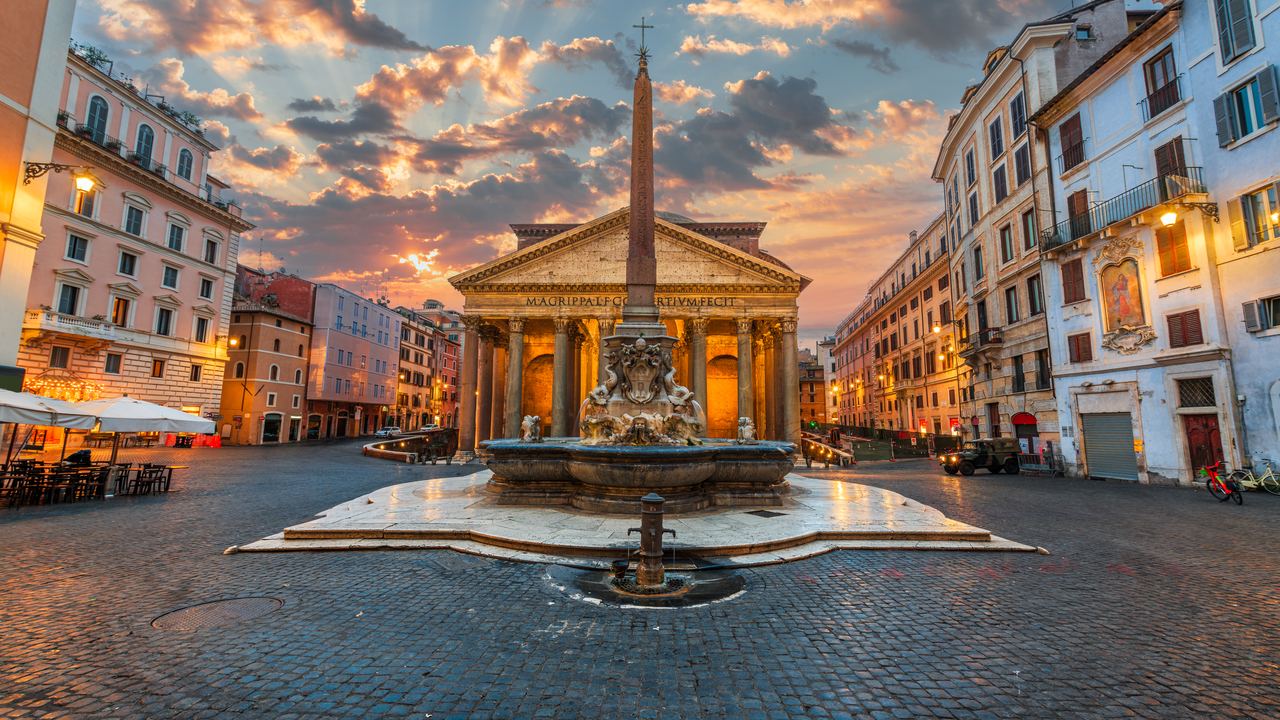
Most monuments have an opening time and that is the whole of their calendar. This one is also a parish church and a national mausoleum, which gives it a year with actual shape: days when it is free, days when something falls out of the ceiling, and one day when the sunlight does something it does not do the rest of the year.
Two of the important dates move. We have calculated them for the next two years rather than telling you to look them up.
Pentecost, and the rose petals
At the end of the 10:30 Mass on Pentecost Sunday, firefighters who have climbed onto the dome drop thousands of red rose petals through the oculus. They fall the full forty-three metres into the rotunda, slowly, in a wide drifting column, onto the heads of whoever is standing underneath.
The rite is medieval in origin, the petals standing for the tongues of fire of the Holy Spirit. It lapsed for a long period and was revived in 1995, so anyone describing it as an unbroken tradition since the Middle Ages is being generous with the word unbroken. It is performed by the Vigili del Fuoco, Italy's fire service, which is a detail worth keeping: this is one of the few religious ceremonies in Rome carried out by a state emergency service.
Entry is free and cannot be booked. Places are limited to whoever fits. People start queuing well before the Mass, and if you turn up at 10:25 you will not get in.
| Date | What happens | Bookable |
|---|---|---|
| 16 May 2027 | Pentecost. Petals through the oculus after the 10:30 Mass, around midday | No. Free, first come |
| 4 June 2028 | The same, the following year | No |
| 21 April, every year | Rome's birthday. The sunbeam crosses the doorway at about 12:59 | No. Just be inside |
| 28 March 2027, 16 April 2028 | Easter, with Easter Monday after it | Normal ticketing, very busy |
| 13 May | Anniversary of the dedication as a church | Normal ticketing |
| 1 and 2 November | All Saints, then a Mass for the kings and queen buried here | Normal ticketing |
| 4 November | Mass for the Italian war dead | Normal ticketing |
| First Sunday, every month | Free entry, no slots, one queue | No. Nothing is bookable |
| 25 December and 1 January | Closed. The only two days of the year | - |

21 April
The day the light crosses the door
Around Rome's traditional birthday the midday sunbeam from the oculus comes down the entrance wall and passes across the bronze doorway. It is the most photographed thing this building does apart from simply existing.
Three things to know before you plan a trip around it. It happens at about 12:59, not at noon, because of summer time and because the building is turned four degrees west of north. It happens on the days either side too, roughly the 18th to the 24th. And it happens again in the third week of August, symmetrically about the solstice, which is the single best argument against the idea that the Romans aimed the building at this specific date.
We calculated the whole year of it, month by month, on a page of its own.
Twelve free Sundays, and what they cost you
On the first Sunday of every month the Pantheon is free, along with every other Italian state museum. That is a genuinely good policy and it has three consequences worth planning around.
Nothing can be booked, so the time slots do not operate and everybody joins one queue. Oltre il Pantheon does not run, so the one product that gets you behind the rotunda is unavailable. And any tour sold with a guaranteed entry time on that date cannot deliver it, which two of the better products in the catalogue say plainly in their conditions and most say nothing about at all.
If you are in Rome for a week and one of those Sundays falls inside it, the free day is a fine day to go somewhere else and see the Pantheon on the Tuesday.
The parish year
Alongside the tourist calendar there is a liturgical one, and it takes precedence. Mass is at 17:00 on Saturdays and eves of feasts, and 10:30 on Sundays and feast days; during the service, entry is free but sightseeing is not permitted.
The Chapter also keeps fixed dates in its constitutions: 13 May, the anniversary of the dedication; 1 November, All Saints; 2 November, a Mass for the Italian royal family buried in the building; and 4 November, for the war dead. The Military Ordinary of Italy is ex officio the head of the basilica, which is how a Roman temple ends up holding an annual service for fallen soldiers.

August
The evening opening, and why it is not in the table
In August 2026 the Pantheon opened from 19:00 to 23:00, every day except Thursday. Seeing that room lit and half empty, with the oculus a black disc instead of a bright one, is a completely different experience from the daytime visit.
It was a trial, agreed at the end of July 2026 under a specific arrangement, and it is not an annual fixture. We have deliberately kept it out of the calendar above, because a page that promises night opening every August will eventually be lying to somebody.
If you are travelling in August, check the ministry's site in the second half of July. That is when the decision is made, and it is made late.
Dates and events
When is the rose petal ceremony at the Pantheon?
On Pentecost Sunday, at the end of the 10:30 Mass, so around midday. That falls on 16 May 2027 and 4 June 2028. Firefighters drop the petals through the oculus. Entry is free, unbookable, and limited to whoever fits, so arrive very early.
Is the petal ceremony an ancient tradition?
The rite is medieval in origin, but it lapsed and was revived in 1995. Descriptions of it as continuous since the Middle Ages are not accurate.
What happens on 21 April?
Rome's traditional birthday, and the day the midday sunbeam crosses the bronze doorway, at about 12:59 rather than noon. The same alignment occurs on the days either side and again in the third week of August.
When is the Pantheon free?
Every first Sunday of the month, twelve times a year, and during Mass for those attending. On free Sundays nothing can be booked, the time slots do not operate and the visit behind the rotunda does not run.
Is the Pantheon open on Christmas Day?
No. 25 December and 1 January are the only two days it closes. It is open on Easter, 1 May, 15 August and every other Italian holiday.
Can I visit the Pantheon at night?
Normally no; it closes at 19:00. There was an evening opening trial in August 2026, decided at the end of that July. It is not a standing arrangement, so check in mid-July if you are travelling that month.
The year from inside the room
The calendar above is the one with dates on it. There is a second one, which nobody prints, and it is the reason the same building feels different in February and July.
The light moves all year and never repeats. From roughly November to February the disc of sunlight sits high on the dome, thirty-odd metres up, and the room below stays dim: the coffers throw long shadows and the interior reads as a cave with a hole in it. By the equinox in March the beam has come down to the springing of the dome, just above the doorway. Through April it crosses the great bronze door itself. From early May to mid-August it reaches the pavement, and that is the version most photographs show, though it is true for less than a third of the year.
The temperature follows the same curve, slowly. A stone room 43 metres across with a permanent opening in the ceiling has no heating and no cooling, and it lags the street by hours. In August, when the city is above 31 degrees by the afternoon, the rotunda is one of the few places in central Rome that is genuinely cool without being air-conditioned. In January it is the opposite: come dressed for outside, because inside is outside.
And in autumn it rains indoors. November brings 112.8 mm across nine or ten days, more than any other month, and the water comes straight through the oculus onto the marble. A column of rain falling forty-three metres in front of you is the single most memorable thing this building does, it happens on ordinary weekday mornings when the square is half empty, and no tour operator can sell it to you.
Data verified on. Mass times and fixed dates from the Chapter's constitutions. Free Sundays and closures from the Ministry of Culture. Petal ceremony details from the Vigili del Fuoco. Moveable feasts calculated.