
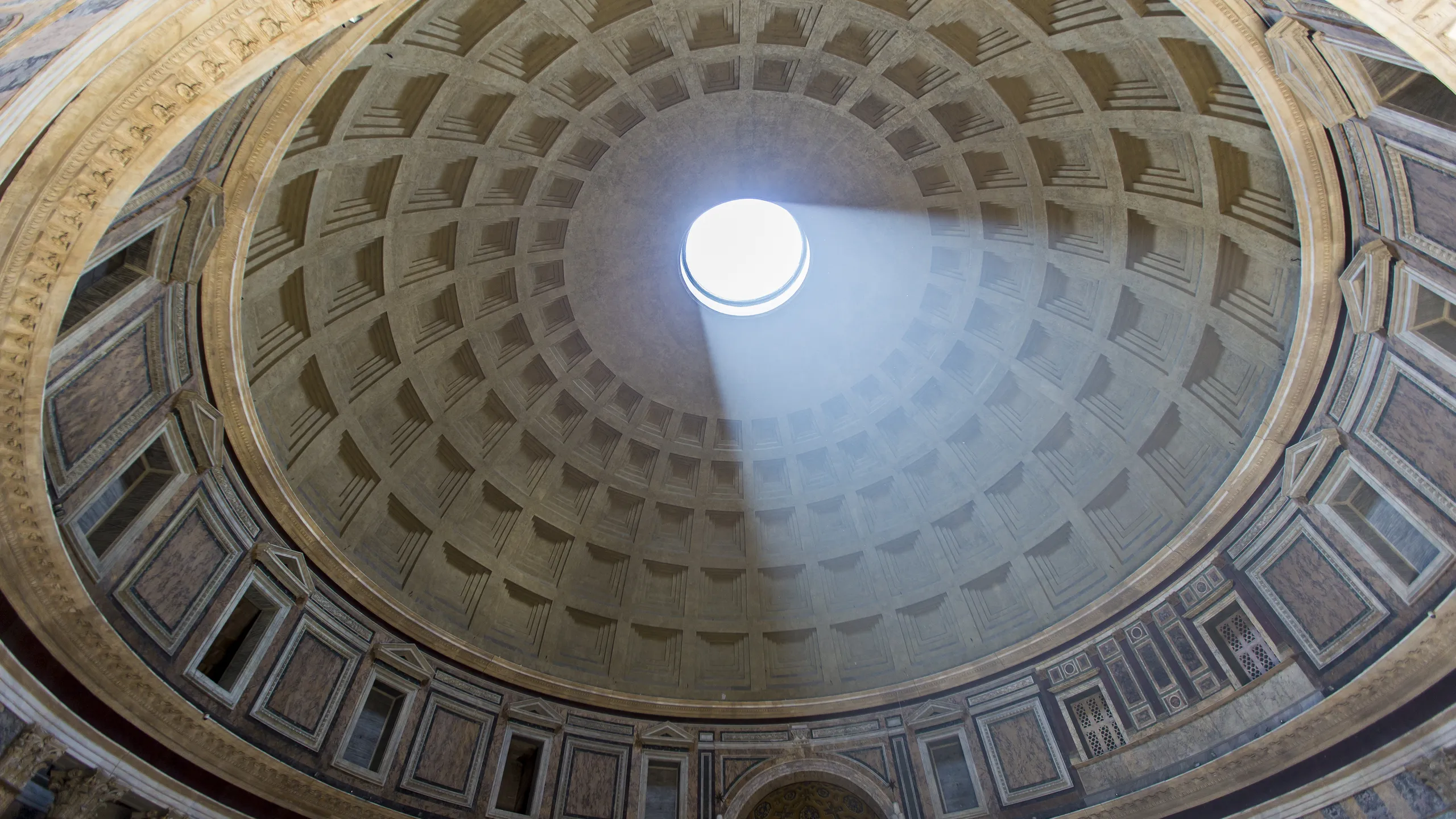
The Pantheon has one window and it is a hole. Nine metres across, at the top of the dome, open to the sky since the second century. Every bit of daylight in the room comes through it, which means the interior changes through the day and through the year in a way that can be worked out on paper rather than guessed at.
So we worked it out. What follows is where the disc of sunlight actually lands, month by month, and at what time by the clock. As far as we can tell nobody else publishes this, and the reason is probably that it needs two separate calculations bolted together: where the sun is, and what shape the room is. Neither is hard. Putting them side by side is the part that gets skipped.
The room is a sphere sitting on the floor
The interior diameter of the rotunda and its interior height are the same, roughly 43.3 metres. Stand in the middle and you are inside the top half of a ball whose bottom half would fit exactly into the cylinder holding it up. The cylindrical wall, the drum, rises to about 21.7 m, which is precisely half the height. Above that line the curve begins.
That one proportion decides the whole business of the light. The beam comes in through the oculus nine metres wide and travels down at whatever angle the sun happens to be at that moment. High sun, steep beam, and it reaches the pavement. Low sun, shallow beam, and it lands on the wall instead, or higher still on the dome itself.
The dividing line is a sun height of 63.4 degrees. Above it the disc hits the floor. Below it the disc is still on the wall by the time it crosses the room. Rome sits at 41.9 degrees north, and the midday sun clears 63.4 degrees for about a hundred days a year. That is the whole of the Pantheon's floor season, and it is shorter than most people assume.
| Date | On the axis | Sun's height | Where the disc lands |
|---|---|---|---|
| 21 January | 12:04 CET | 28 degrees | High on the dome, 33.7 m up |
| 21 February | 12:09 CET | 37 degrees | Dome, 27.3 m up |
| 21 March | 12:05 CET | 48 degrees | Drum wall, 19.0 m up, just below the springing |
| 21 April | 12:59 CEST | 60 degrees | Across the doorway, centred 5.9 m up |
| 21 May | 12:59 CEST | 68 degrees | Floor, 17.3 m from the centre |
| 21 June | 13:05 CEST | 71.5 degrees | Floor, 14.5 m from the centre |
| 21 July | 13:09 CEST | 68.5 degrees | Floor, 17.0 m from the centre |
| 21 August | 13:04 CEST | 60 degrees | Across the doorway, centred 5.6 m up |
| 21 September | 12:51 CEST | 49 degrees | Drum wall, 18.6 m up |
| 21 October | 12:40 CEST | 37 degrees | Dome, 27.4 m up |
| 21 November | 11:39 CET | 28 degrees | Dome, 33.7 m up |
| 21 December | 11:50 CET | 24.5 degrees | Dome, 35.8 m up |
Whatever you have read, it does not happen at noon
This is the part that trips up almost every account of the building, and it trips up two things at once.
The first is the clock. Rome sits at 12.5 degrees east, but Central European Time is anchored to the meridian at 15 degrees, so local solar noon already runs about ten minutes late. Add summer time from the last Sunday in March and you have pushed midday past one o'clock. On 21 April the sun is at its highest over Rome at 13:09, not 12:00.
The second is the building. The Pantheon is not aligned to true north. Its axis runs about 4.4 degrees west of it, which means the beam sweeps across the doorway before the sun reaches due south rather than at the same moment. On 21 April that puts the alignment at about 12:59. Gilles Montambaux timed the transit on site and got the same answer; our calculation and his measurement agree to within a minute, which is reassuring for both.
An hour is a big error to make about a building people travel to see. Turn up at noon in April and you will watch the light in the wrong place, then go home thinking the stories were exaggerated.

The aperture
How wide is the oculus, exactly
Even this is not settled. Hannah and Magli give 8.3 m in their 2011 paper. The Cambridge volume on the building, following Pelletti's survey, gives 30 Roman feet, or about 9 m. That is a gap of seven or eight per cent, and it matters more than it looks: part of the argument for a deliberate solar design rests on the oculus having been sized to produce a particular effect.
We used 9 m. Had we used 8.3, every landing point in the table would sit in exactly the same place, because the centre of the beam depends on the sun and on the shape of the room, not on the size of the hole. Only the spread of the lit patch changes.
The floor season, and why the light never reaches the middle
By our calculation the beam first touches the pavement on 3 May and leaves it on 11 August. Either side of those dates it is climbing or descending the wall.
What surprises people is that even at the summer solstice the disc does not arrive at the centre of the room. On 21 June its middle sits 14.5 metres from the centre of the floor, well out towards the north side. For the beam to land dead centre the sun would have to be directly overhead, and that only happens between the tropics. Rome is at 41.9 degrees north and never sees the sun higher than about 71.5 degrees. The pavement under the oculus is never lit straight on, and has not been once in nineteen centuries.
The April claim, and how much of it holds
The interesting date is 21 April, Rome's traditional birthday. Around then the beam comes down the entrance wall and passes across the great bronze doorway, which is 7.53 m high. Our figures put the centre of the disc at 5.9 m that day, with the lit patch covering the doorway from the floor up to roughly fifteen metres.
In 2011 Robert Hannah and Giulio Magli published a paper in Numen arguing that this was designed, and that an emperor entering on that date would have walked in with the sunlight. It is a lovely idea, and it is worth being clear about which parts of it are which.
The movement of the beam is arithmetic. Anyone can reproduce it, we just did, and Hannah and Magli photographed it on 21 April 2007. Marina De Franceschini photographed it again in April 2014. The phenomenon is real and nobody disputes it.
The intention is a hypothesis, and the authors say so themselves: they write that if we suppose the emperor was celebrating that day there, his entrance would have been symbolic. They also state plainly that they are not arguing the building was meant to measure the sun. Eugenio La Rocca reached a similar reading of the April alignment independently, before their preprint appeared, and then applied the brakes himself, calling solar-clock interpretations of the rotunda too ambitious for the evidence. The Cambridge volume, the standard reference on the monument, does not engage with the theory at all.
There is also a blunt arithmetic objection. 21 April is not astronomically special. The sun reaches the same height on the 18th and the 24th, and again in the third week of August, symmetrically about the solstice. Our own table shows it: the disc sits 5.9 m up on 21 April and 5.6 m up on 21 August. If the building was aimed at a date, the sky cannot tell you which of the two it was.
All the astronomical analysis which follows does not aim to show that the Pantheon was designed to make precise measurements of the sun's cycle.
Yes, the rain comes in
Guides in the square will tell you that rain never falls inside, that warm air rising through the oculus breaks up the drops before they land. Good story. Also wrong, and the basilica's own website says so: when it rains, water falls onto the marble and drains away.
The historical evidence is blunter than any weather argument. Four centuries of popes tried to close the oculus to keep water out, from Giacomo della Porta in 1591 to Alexander VII in 1660 to James Gibbs in the eighteenth century. In 1880 a proposal to put a tomb in the middle of the floor was turned down partly because the ancient drains underneath would not have coped. Nobody spends three hundred years solving a problem that does not exist.
You will also read that the floor has exactly twenty-two drainage holes. We could not stand that up. The number appears on tourist sites and on the Italian Wikipedia page, where it is flagged as unsourced, and it is absent from the Cambridge volume and from the archaeological literature. The drainage is real and documented. The count is not, so we are not printing it as though it were.
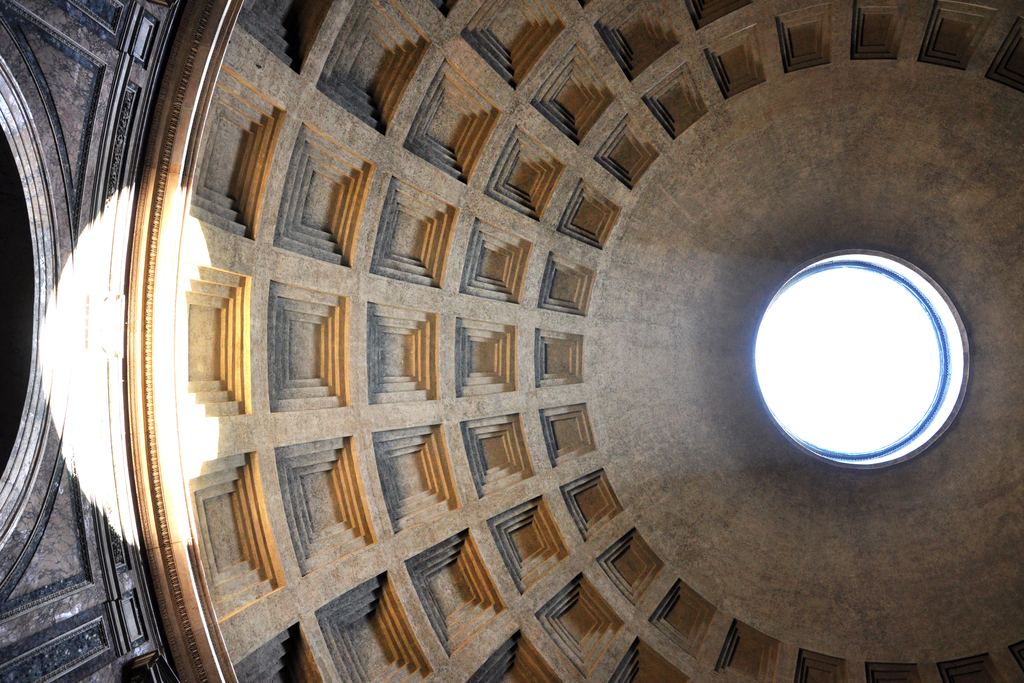
Where to stand
If you want to see the beam properly
Between May and early August, come in the middle of the day and stand on the south side, with the door behind your left shoulder. The disc will be on the floor ahead of you, towards the entrance.
From September to April the light is up on the wall or the dome, which is honestly the better show: the coffers throw shadows that shift while you watch, and the lit patch slides across the curve. In the fortnight around 21 April, and again around 21 August, be inside by about a quarter to one.
A cloudy day gives you nothing at all. There is no artificial substitute, because there is essentially no artificial lighting.
Questions about the light
What time does the sunbeam cross the Pantheon's doorway on 21 April?
Around 12:59 CEST. Not noon. Two things push it: Italy keeps a clock anchored to a meridian well east of Rome, and summer time adds another hour, so solar noon that day falls at 13:09. The building is then turned about 4.4 degrees west of north, so the beam crosses its axis roughly ten minutes before the sun reaches due south.
When does the sunlight reach the floor of the Pantheon?
Between about 3 May and 11 August. The midday sun has to be higher than 63.4 degrees for the beam to clear the wall, and in Rome that happens for roughly a hundred days a year. Outside that window the disc lands on the drum wall or high on the dome.
Does the beam ever land in the centre of the floor?
No, and it cannot. That would need the sun directly overhead, which only happens between the tropics. At the summer solstice the centre of the disc is still about 14.5 m from the middle of the room.
Does rain come through the oculus?
Yes. The idea that rising warm air disperses the drops is folklore; the basilica itself says the water falls onto the floor and drains away. Four centuries of papal schemes to close the opening make the same point rather forcefully.
Was the Pantheon deliberately designed around the sun?
Unresolved. Hannah and Magli argued in 2011 that it was, and Eugenio La Rocca read the April alignment the same way independently. But La Rocca himself called solar-clock readings too ambitious for the evidence, the standard Cambridge reference does not engage with the theory, and 21 April is not an astronomically unique date: the same alignment recurs in the third week of August.
Seeing it with someone who knows the building
Forty to ninety minutes inside with a licensed guide. Every experience below includes admission to the monument.
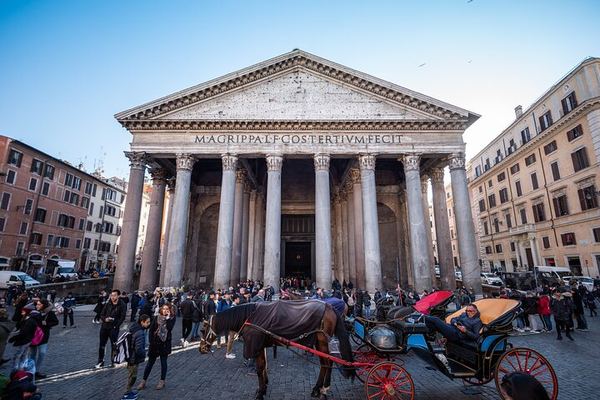
Pantheon Elite Tour: 50 to 60 Minutes with a Native-Speaking Guide
An hour is the deliberate length here, meeting outside Antica Salumeria, and the ground itself gets covered: the Campus Martius and Romulus.
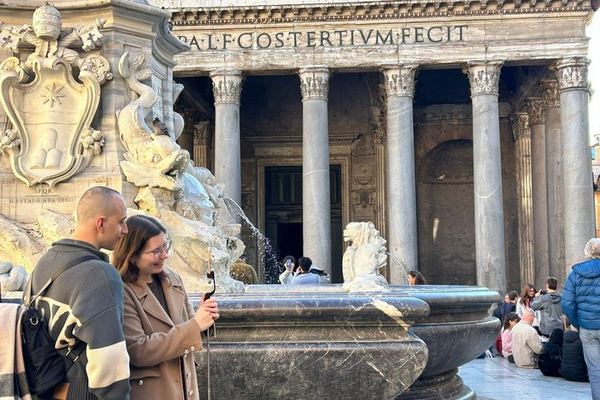
Pantheon Entry with a Walk from Campo de' Fiori and Largo Argentina
The walk starts at Touristation Navona and takes in Campo de' Fiori and the sunken temples of Largo Argentina before the Pantheon, wine tasting optional.
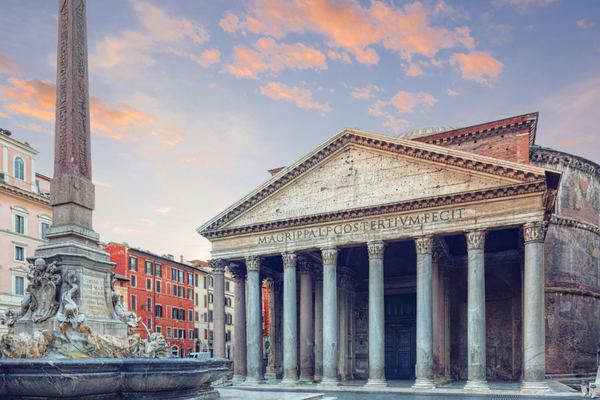
Pantheon Fast-Track Ticket and Guided Tour of the Rotunda
A guide walks the room Michelangelo praised, and the dome's numbers explain it: concrete 5.90 metres thick at the base, 1.50 at the rim of the oculus.
Ratings collected by Viator, Tripadvisor and Tiqets
Data verified on. Sun positions computed with the NOAA algorithm for 41.8986 N, 12.4767 E and checked against a published on-site timing. Geometry from Marder and Wilson Jones, The Pantheon (Cambridge, 2015).