
Pantheon Museum · Tour
Roman Pizza, Supplì, and the Queen Margherita Story
Roman pizza is thinner and crisper than Neapolitan pizza. That is the first thing you taste on this walk, and the difference is easier to understand with a slice in your hand than in a paragraph. The walk starts in Piazza Trilussa and goes to Piazza di Santa Maria, where you order a homemade pizza to take away from a proper pizzeria. That is where the guide gets into Margherita of Savoy, the queen credited with putting her name on the pizza in the 19th century, a story that is told everywhere in Italy and that historians have been picking at for years. The version you will hear is that a Neapolitan pizzaiolo called Raffaele Esposito made her one in tomato, mozzarella and basil in 1889 and had it named in her honour. The document behind it is a letter of thanks whose authenticity has been challenged, and the name itself takes a surprisingly long time to turn up in print afterwards. It is also a Neapolitan story being told in Rome, which is part of why a Roman guide enjoys telling it. Rome's own contribution is the other kind. Pizza al taglio is baked in long trays, sold by weight instead of by the slice, and cut with scissors to whatever length you point at. It came out of the post-war decades here and it is still how the city eats at midday, standing up, folded in paper. Next a supplì stand: rice balls with cheese and tomato, fried, which are a Roman thing and not something you will find done the same way elsewhere in Italy. The Sicilian arancino is what people confuse them with, and the two are different objects. An arancino is larger, made with saffron rice, and shaped into a cone or a sphere; a supplì is an oval that fits in one hand. Then a busy Trastevere gelateria. One test you can use for the rest of the trip: good gelato sits low in covered steel tubs at a temperature that keeps it looking dull, rather than heaped into bright peaks on open display. It finishes back near Piazza di Santa Maria at a tavern, sitting down with a glass of Italian wine and a board of cheese and prosciutto. It works as lunch or as dinner, depending on the departure you book. The midday walk is hotter and the streets are emptier; the evening one moves through Trastevere as it fills up, which is the neighbourhood at its most itself and also at its most crowded. One thing the operator states plainly: the tastings shift a little with the season, though they always stay typical products of the same value and quality as those listed. Cancellation here is three days, not the usual twenty-four hours. After that, and for no-shows, there is no refund. In practice that turns it into a decision taken before the trip rather than during it, because by the time you have landed in Rome the money is already committed. Three hours across four stops is a slow pace, and the food adds up to a light meal rather than a full one, so leave room in the day either side. A bottle of water is included, which in July is not a token gesture; beyond that, the cast-iron street fountains Romans call nasoni run cold drinking water all over the centre and cost nothing. The meeting point is straightforward. Piazza Trilussa is the small square on the Trastevere bank at the end of the footbridge, with a broad flight of steps and a fountain set into the wall behind them, taken down on the far side of the river and rebuilt here in the 1890s when the Tiber embankments went up. People sit on those steps all evening, so expect company while you wait.
What's included
- English–speaking guide
- Tastings
- Bottle of water
Itinerary
The map could not be loaded. Please try again in a moment.
Plaza Trilussa
Keep exploring
More experiences in Food Tours of the Centre
-
 Free cancellation
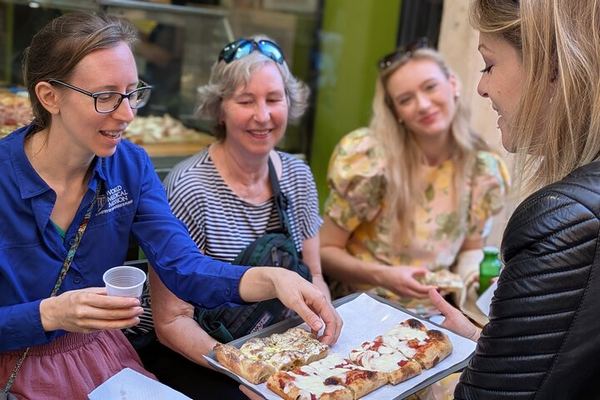
An 1870 Bakery and a Fountain Drawn in 1471: Trastevere on Foot
4.9 (450) 4.9 stars out of 5, 450 reviewsPizza from a bakery running since 1870, and a fountain already drawn on a map of Rome in 1471. Two and a half hours, ten people, not for coeliacs.
€ 49.00 -
 Free cancellation
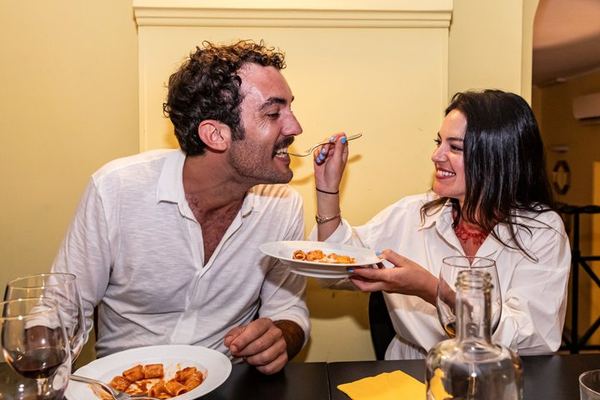
A Wine Cellar Older Than the Colosseum: Ghetto and Trastevere
5.0 (278) 5.0 stars out of 5, 278 reviewsTen stops including Da Enzo al 29 and Spirito Divino, both Slow Food. Morning departures taste at the market; evening ones eat fried street food.
€ 119.00 -
 Free cancellation
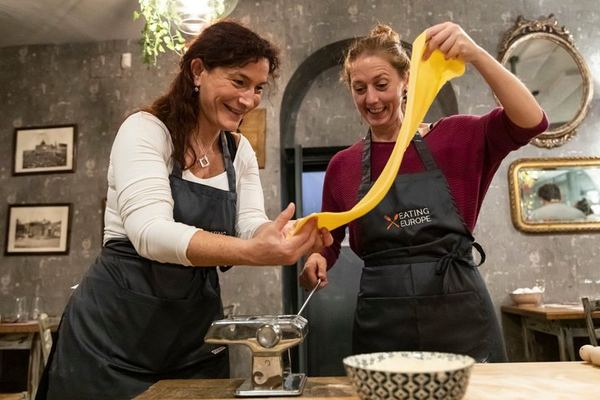
Buy the Eggs, Then Make the Pasta: A Trastevere Class
4.9 (525) 4.9 stars out of 5, 525 reviewsThe shopping comes first, at a neighbourhood butcher, and you eat the ricotta you watched being bought. Porchetta and wine while it happens.
€ 89.00
Ratings collected by Viator and Tripadvisor