
Pantheon Museum · Tour
Hidden Rome by Car: the Appian Way, Catacombs and Aqueducts
A private day with an English-speaking driver, built for people who have already done the centre or would rather skip it. The car collects you at your hotel in the morning and drives out of the city, which is where the difference starts. The Appian Way, the catacombs of San Sebastiano and the aqueduct park are all outside the walls, and none of them is reachable on a walking tour. The Appian Way was built in 312 BC by Appius Claudius Caecus, ran first to Capua and eventually more than three hundred miles to Brindisi, and was called the queen of roads. Long stretches of the original paving are still down, worn smooth by two thousand years of wheels and feet. The catacombs of San Sebastiano gave the word catacomb to every Christian cemetery that followed: the name comes from ad catacumbas, near the hollows, after the tuff quarries here. The Parco degli Acquedotti has kilometres of the Aqua Claudia and the Aqua Felix standing across open meadows with umbrella pines, and almost no visitors at all: at weekends it is Roman families with picnics. The day comes back in for the Baths of Caracalla, the Tiber, Trastevere and the Janiculum.
What's included
- Hotel pickup and drop-off
- Local guide
- Private tour
- Catacombs admission fee
Show 2 moreShow less
- Driver/guide
- Transport by private vehicle
Itinerary
The map could not be loaded. Please try again in a moment.
Appian Way (Via Appia Antica)
The Appian Way was the road that held the empire together, running from Rome to its furthest settlements. Appius Claudius Caecus, censor of Rome, built the first stretch to Capua near Naples; it was later extended more than three hundred miles to Brindisi on the Adriatic, making it the widest and longest road then in existence. Romans called it the queen of roads, and it was begun in 312 BC. It has also come down in better condition than most Roman sites: large flat stones, pressed into place by two thousand years of rain, wheels and feet.
Catacombe San Sebastiano
This cemetery is named for the martyr Sebastian, who is buried here, and was originally called ad catacumbas, near the hollows, after the tuff quarries in the area. That name was later applied to every underground Christian cemetery, which is where the word comes from. It was also known as the Apostolic Memorial, from the celebrations for Peter and Paul held here for a period in the early centuries. From the first century the site was heavily quarried and built on. The caves and tunnels were reused for pagan and Christian wall tombs and for smaller niches holding urns, and at least two houses stood above ground, notable for their painted interiors.
Parco Archeologico dell'Appia Antica
The Parco degli Acquedotti sits on the edge of the city and is among the most interesting open spaces in Rome, and among the least visited. The aqueducts were built to carry fresh water from the mountains and the countryside into the city, and the fact that they are still standing is the argument for Roman engineering in a single view. A few miles from the centre, the park holds long runs of the Aqua Felix and stretches of the Aqua Claudia. Wide meadows, umbrella pines and enormous ruins cutting across them. At weekends the grass under the arches fills with Roman families having lunch, and you can walk it or hire a bike.
Terme di Caracalla
The Baths of Caracalla were built between 212 and 216 under Marcus Aurelius Antoninus Augustus, known as Caracalla, and were among the largest thermal complexes of the ancient world. Only the brick walls and the collapsed vaults are left, and they are still enough to give you the scale of the place.
Extra fee
Fiume Tevere
The Tiber is the second longest river in Italy after the Po, roughly 250 miles long and between seven and twenty feet deep. It rises in the Apennines at Monte Fumaiolo and reaches the Tyrrhenian Sea at Ostia. Most of Rome lies on its east bank; the west bank, including the island, was Region XIV in the administrative division Augustus made of the city.
Trastevere
Trastevere sits downriver from the Vatican and works as a city inside the city, with its own identity and a well-developed Roman contempt for gentrification. Civic pride runs strong through the medieval maze of squares and cobbled alleys. Locals here support the neighbourhood football club as readily as the capital's famous one, which tells you most of what you need to know. None of that makes it unwelcoming. Sitting on the steps in Piazza Trilussa or ordering a coffee at a bar counter is enough to be part of it.
Basilica di Santa Maria in Trastevere
One of the oldest churches in Rome, recently restored, which has brought back the twelfth-century mosaics by Pietro Cavallini, including his Life of the Virgin, along with later frescoes and marble. The gilded octagonal ceiling holds Domenichino's Assumption of the Virgin, painted in 1616 and 1617. The church goes back at least to the third century and has a reasonable claim to being the first official Christian place of worship in the city.
Colle del Gianicolo
The Janiculum gives the best view over central Rome, its domes and bell towers laid out below. On the hill are San Pietro in Montorio, long held to be the site of Peter's crucifixion, and Bramante's Tempietto marking the supposed spot. There is also the Fontana dell'Acqua Paola, the Baroque fountain built for Pope Paul V, and a run of foreign institutions: the American Academy, the Spanish Academy, the American University of Rome, the Pontifical Urban University and the North American College, along with the botanical garden of La Sapienza and the Palazzo Montorio, residence of the Spanish ambassadors.
Not included
- Food and drinks
- Gratuities
Good to know
- Infants and small children can ride in a pram or stroller
- Service animals allowed
- Specialized infant seats are available
- Travelers should have at least a moderate level of physical fitness
Show 4 moreShow less
- Due to the Jubilee, some monuments may be under restoration. Please pay attention to any messages we may send regarding potential changes.
- Up to 8 travelers per booking.
- Mobile or paper ticket accepted
- Guiding available in: en.
Reviews
Loading reviews…
Keep exploring
More experiences in Hidden Gems & Secret Corners
-
 New
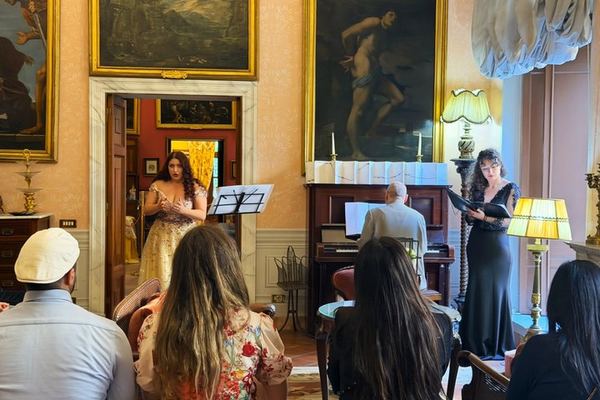
NewConcert in the Secret Apartments of Palazzo Doria Pamphilj
4.7 (7) 4.7 stars out of 5, 7 reviewsSoloists of the Romaeterna Cantores Female Ensemble under Aurelio Porfiri, in rooms built for conversation and never for amplification.
Discounted price€ 33.60Regular price€ 42.00 -
 Free cancellation
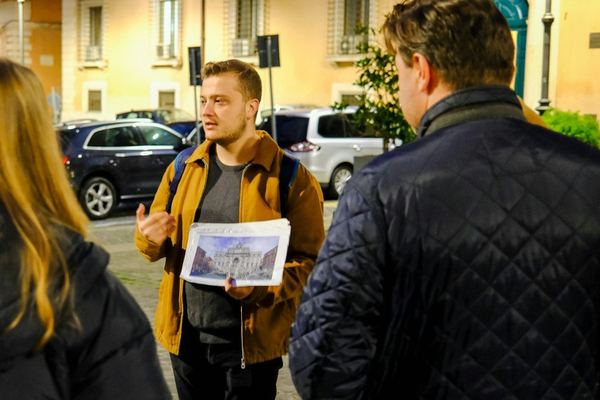
Guided Walk from Piazza d'Aracoeli to Piazza Navona
4.6 (8) 4.6 stars out of 5, 8 reviewsCovers Piazza Venezia, the Trevi Fountain and the outside of the Pantheon on foot. Entry to the Pantheon is not included in this walk.
€ 20.00 -
 Free cancellation
Private Trastevere Food Walk: Innocenti, Caciara, Otaleg
5.0 (4) 5.0 stars out of 5, 4 reviewsThree and a half hours from the Tiber Island through named shops: biscuits since 1940, a cheese counter since 1900, gelato churned by Marco Radicioni.
€ 370.00
Ratings collected by Viator, Tripadvisor and Tiqets