
Pantheon Museum · Tour
Marcellus to the Turtles: Trastevere and the Ghetto on Foot
The Theatre of Marcellus looks like a small Colosseum, and the resemblance runs the other way round: it was finished in 13 BC, decades before the Colosseum, and the stacked arches of its facade set the pattern the later building followed. Flats were built into the upper storeys in the Middle Ages and people still live in them, which is why the top of a Roman theatre has curtains in the windows. The walk starts in Piazza Trilussa on the Tiber and goes through the cobbled streets of Trastevere to the Basilica of Santa Maria in Trastevere. The bridge at the starting point is Ponte Sisto, built for Sixtus IV in time for the Jubilee of 1475 on the piers of a Roman crossing. It exists because of a disaster: during the Jubilee of 1450 the crowd on Ponte Sant'Angelo panicked, around a hundred and seventy people were crushed or drowned, and Rome concluded it needed a second way across the river. Then down to the river, over the Ponte Cestio onto Tiber Island, where the Basilica of St Bartholomew stands. The island has been in the same line of work for well over two thousand years. A temple to Aesculapius, the god of medicine, was founded on it in 291 BC after a plague, and there is a working hospital on it now, run by the Fatebenefratelli since the sixteenth century. On the far arm, the Ponte Fabricio of 62 BC still carries people on its original stones, which makes it the oldest bridge in the city. On the far bank, the Jewish Quarter: the Theatre of Marcellus, the church of Sant'Angelo in Pescheria and the Portico d'Ottavia beside it. Augustus rebuilt the portico and named it for his sister Octavia. Rome's fish market ran under its arches for centuries, which is where the church gets the name in pescheria, and a marble slab still fixed to the wall records the rule that the heads of fish above a certain length belonged to the city magistrates. The quarter itself was created by decree. Paul IV walled the Jews of Rome into this low, flood-prone bend of the river in 1555 and required them to live in it, and the gates were not taken down for good until 1870. On 16 October 1943 the neighbourhood was raided at dawn and more than a thousand people were deported; sixteen came back. Small brass plates are set into the paving in front of the doors they were taken from, and the route walks over them. After that, Piazza Mattei and the Fontana delle Tartarughe, where the guide tells the story attached to it, which involves a night, a debt and four bronze turtles that were added long after the fountain was built. The fountain is by Giacomo della Porta and Taddeo Landini and dates from the 1580s; the turtles arrived around 1658 during a restoration and are generally given to Bernini. The route continues along Via Arenula, past the church of Santi Biagio e Carlo ai Catinari, and ends at the door of Santa Barbara dei Librai, a few steps from Campo de' Fiori. This one is a guided walk rather than a tasting tour: no food is included. The other exclusion is the inside of the Great Synagogue, which the route passes but does not enter. Its square dome is the only one of that shape on the Roman skyline, built between 1901 and 1904 to resemble nothing else in the city, and the Jewish Museum beneath it has its own ticket and its own security check. If you want it, keep a separate hour for it on another day. Three hours on foot, with headsets provided. Those matter here, because the Ghetto streets are narrow and lined with restaurant tables and a group cannot close in a ring round a guide. Nothing on the route is ticketed and nothing else needs booking, so what the day actually asks for is walking shoes and, between June and September, a hat. Cancellation is free up to three days before. After that, and for no-shows, there is no refund.
What's included
- English speaking guide.
- Headset to hear the guide during the tour.
Itinerary
The map could not be loaded. Please try again in a moment.
Piazza Trilussa.
Not included
- Visit inside the Synagogue
Keep exploring
More experiences in Food Tours of the Centre
-
 Free cancellation
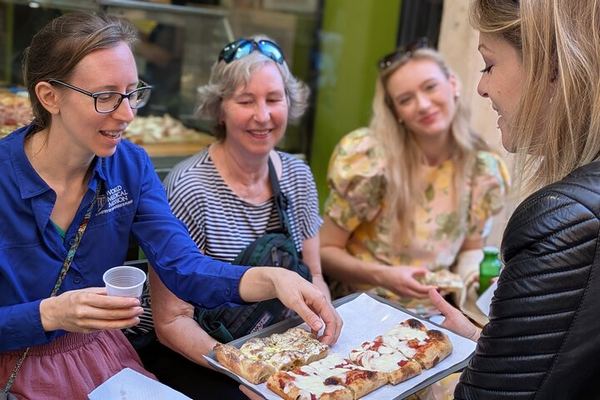
An 1870 Bakery and a Fountain Drawn in 1471: Trastevere on Foot
4.9 (450) 4.9 stars out of 5, 450 reviewsPizza from a bakery running since 1870, and a fountain already drawn on a map of Rome in 1471. Two and a half hours, ten people, not for coeliacs.
€ 49.00 -
 Free cancellation
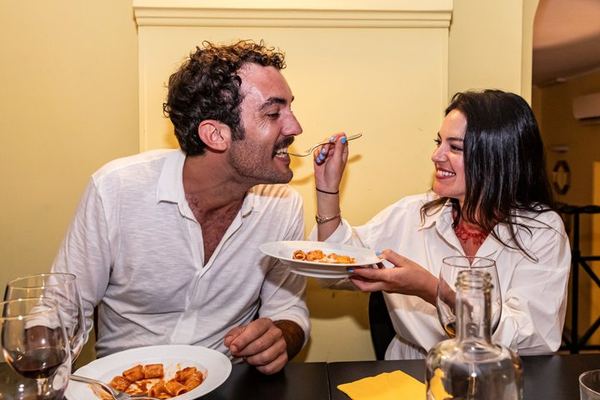
A Wine Cellar Older Than the Colosseum: Ghetto and Trastevere
5.0 (279) 5.0 stars out of 5, 279 reviewsTen stops including Da Enzo al 29 and Spirito Divino, both Slow Food. Morning departures taste at the market; evening ones eat fried street food.
€ 119.00 -
 Free cancellation
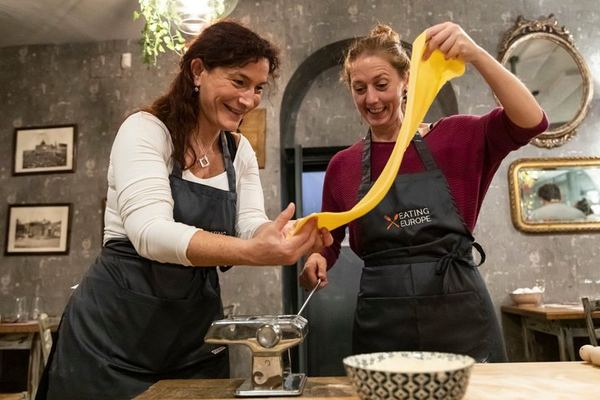
Buy the Eggs, Then Make the Pasta: A Trastevere Class
4.9 (525) 4.9 stars out of 5, 525 reviewsThe shopping comes first, at a neighbourhood butcher, and you eat the ricotta you watched being bought. Porchetta and wine while it happens.
€ 89.00
Ratings collected by Viator and Tripadvisor